Many people end their day by turning on the evening news to catch up with what’s going on in the world. Inevitably there are three standard stories each night: one about a local car crash; one about a murder or theft; and one about a young person who was sexually abused by a neighbor, teacher, coach, adult friend, family member, parent, or minister.
I am close to adults who, in their youth, were sexually violated; some by educators, others by family or friends, and those who were betrayed in the most abhorrent way – by their parents or a priest. The scars left in the wake of their abusers’ perverted sexuality have, in most cases, left their victims to live a life fending off deep-seated pain, often immersing themselves in addictions in an effort to numb their inner turmoil.
In all cases the innocent was befriended by a trusted confidante. After the abuse took place, the naive soul was made to believe it was his or her fault; they were the ones who were to blame and were told never to speak a word lest they be punished. They manifested shame to such a degree that the events were never spoken of for decades, and then only after much psychotherapy.
When the multiple accounts of sexual abuse by priests in the Catholic Archdiocese of Philadelphia were brought to the surface, it was as though someone threw a blow to my chest, knocking the wind out of me. All those victims living with so much pain caused my heart to ache. I’ve seen firsthand how this evil turns a wide-eyed, vibrant soul with unlimited potential into a scared, cynical recluse who trusts no one. It’s agony for those who love them, as well as for the victims who protect themselves by pushing love away.
A few days later a testimony was released by the former nuncio to the United States, Carlo Maria Viganò, that addressed many disturbing sins of the hierarchy that have been swept under the carpet for decades. In Mel Gibson’s movie The Passion of the Christ, there is a scene just after Jesus’ death where a tear from heaven falls to the ground and the viewer sees Satan coming unglued because Love won. He screams out in frenzied anguish. This is my reaction to what’s taken place in my church! How could the font of my incalculable joy be the source of immense pain for so many?
In the mid 1990s I found my way back to the faith of my childhood after having been away since age eleven. In my search for God and truth, amid stubborn pride in wanting vehemently to prove the Church wrong in all her teachings, it was the True Presence of Christ in the Eucharist that I could not explain away.
After being shown this video on Eucharistic miracles by a woman who crossed my path, an intrigue was ignited. It was beyond my comprehension that a wafer of bread could be transformed into actual flesh. And not just once — there was scientific documentation, independent of the Church, of more than a hundred instances of this phenomenon since the eighth century, most of which seemed to occur around times of weakened faith.
All specimens, despite being from miracles hundreds of years apart, were proven by modern-day forensics to be of the same blood type (AB, the same as was identified on the Shroud of Turin) and had identical properties to that of human flesh derived from the left ventricle of the heart. My curiosity would not be satiated until I proved this was a hoax. But the more I read and researched, the deeper I dug, the less I was able to dismiss.
I came to a conclusion: I could choose to remain in my pride and stay in the dark, pretending there was no credibility to the factual evidence of these miracles, or I could begin a journey to finding out more. I chose the latter.
Over the course of a few years, I was introduced to a community of laypeople and holy priests who were authentically Catholic. I learned that everything they did revolved around Jesus. For these people, it wasn’t about warming a pew or going through the motions to fulfill a duty; it was about becoming one with Our Lord at the Eucharistic table — being in communion with Him. As I observed the love with which these people lived their lives and showed others, I envied them. Having never experienced that level of joy, I put aside my pride and got involved because I wanted what they had.
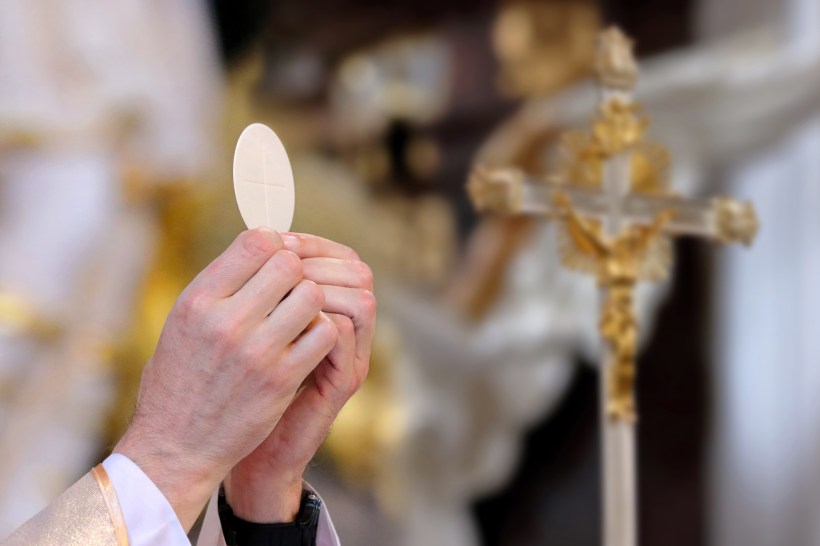
We can’t get any closer to Jesus on Earth than when we receive him at the altar. It is here where he becomes a part of us and, according to the disposition with which we receive him, we begin to take on his properties of love.
This new revelation became the source of strength for me. I didn’t attend Mass on Sunday (or during the week, for that matter) to hear a choir, listen to a sermon, or enjoy fellowship, though these things were bonuses. I didn’t go because the architecture of the building was empyreal or the seating comfortable. I went because I needed to be close to the one person who could change my lot from being hopeless to having happiness beyond measure. My faith was not reliant on believing in a priest, deacon, bishop, cardinal, or even the pope. These men are human and, no matter how good they are, all humans sin and have the potential of letting us down. My faith was in, and increased by, receiving the Source of all love.
It didn’t take long to realize that the more intimate my relationship became with Our Lord, the more temptations were thrown in my path. Sometimes I think people focus on God as being the only supernatural force in the universe and on what he permits and does not permit — mainly the giving and withholding of blessings. Seldom do they stop to realize there is also Satan who is alive and active, doing his most to cause pain, confusion, anxiety, anger, distress, etc.
We don’t live in a one-sided spiritual realm. There has always been an opponent to Love, yet we brush him off as if he were an annoying itch. We don’t like to think there is a powerful evil force who disdains anything good and is capable of horrendous damage, destroying the lives of those who seek to imitate his nemesis. I believe we see this specifically in the lives of priests.
If priests are the helpers Jesus gave us through apostolic succession (each priest, upon ordination, receives the laying on of hands by the bishop, which can be traced unbroken all the way back to Peter) to consecrate hosts into his actual Body and Blood, and knowing Jesus is the supreme nemesis of Satan, isn’t it logical that Satan would seek to destroy the Church by bringing down priests? Without priests, we have no Eucharist; without the Eucharist, no Jesus bodily present and potent.
Evil has gained a lot of ground since the early 1960s with the explosion of the sexual revolution. It has been one of Satan’s greatest masterminded plans. As society pushed for — and welcomed with open arms — the “If it feels good, do it” mentality, the walls of seminaries unfortunately offered no sanctuary from this kind of thinking.
How could they? Random sexual activity, including that between same-sex and multiple partners, was given a green light. The growing acceptance of contraception gave way to no-guilt, no-responsibility relationships. Sex began to replace love. The beauty of intimate, unconditional, reciprocal love devolved into a self-centered search for transitory euphoria.
Somewhere along the line, people forgot priests were men. Just because they wear a collar doesn’t mean they don’t think like men, especially when it comes to the sins of the flesh. It meant they had to work harder in keeping those thoughts and desires channeled into chaste outlets. In spite of being educated against improper physical exchanges with females, their desire to feel physical pleasure like everyone else manifested in distorted forms of release.
Satan knows all our weaknesses, and he’s ever vigilant in trying to seduce us away from God. He doesn’t want us at peace. He wants us chained to sin and misery. Those in the position to lead others to Christ are his greatest targets. While it may seem like he’s winning the war with our Catholic Church, we must look to history for who will eventually win. This isn’t the first time he’s planted seeds of corruption on the inside, and because the Church is run by humans, it won’t be the last.
We can’t undo the havoc evil has wreaked over the past fifty years. The pain caused by the sexual revolution — a revolution that made the effects of narcissism pandemic — is immense. It has fostered deep-seated vices that not only have infiltrated the Church but have found their way into just about every household, mine notwithstanding.
That fact that sexual perversity is everywhere does not excuse the atrocious abuse of pastoral authority by bishops who have allowed men with deep-seated problems to inflict their brokenness on the innocent, causing a ripple effect of brokenness in the lives of their victims. The Church, and those who represent her, should be a safe haven against the world’s evil, not a channel of it. Those in authority who have allowed such contagion to run rampart must be removed from their faculties, immediately. Non-Vatican investigations need to take place and those convicted of crimes should be punished as any other criminal who commits this kind of malefaction.
“Master, to whom shall we go? You have the words of eternal life.” (John 6:67-68)
Understandably, our first response may be to abandon the Church, but that would be the easy way out — and most certainly would please the enemy because, after all, that’s his intent. It would also mean abandoning the vast majority of clergy who join us in disgust at what’s happened, those whose humility and faithfulness keep them out of the limelight, allowing them to persevere behind the scenes; who, despite the accusing looks and hurtful words of undeserved accusation, fight hard to live their lives in purity, upholding the teachings of Christ. These holy men need our support. Just as Jesus asked the apostles, he asks us, “Do you also want to leave?” To which we should reply as Peter, “Master, to whom shall we go? You have the words of eternal life.” (John 6:67-68) Where else can we go to encounter the True Presence of Christ in the Eucharist?
What we can do to remove this putrid stain from the white garment of the Bride of Christ is to fight back by rising up in virtue. Instead of leaving, we need to start leading! Throughout the ages it took courageous saints to root out rot and return the Church to her heavenly splendor. After all, Jesus told Peter, “You are Peter, and on this rock I will build my Church, and the gates of hell will not prevail against it.” (Matt. 16:18) He also said to the apostles, “In the world you will have trouble, but take courage, I have conquered the world.” (John 16:33)
Confident that no matter how hard Satan hits he will not prevail, we are being called to be the St. Peter Damians, St. Francis of Assisis, St. Thomas Mores, St. Philip Neris, St. Theresa of Avilas, St. Joan of Arcs, St. Ignatius of Loyolas, among many others. We need to ask ourselves, “What is disgusting in my life? Where do I compromise? Where is my infidelity or corruption?” and we need to stop it! In order to change the Church, we, the laity, need to begin by changing ourselves; repenting and refusing to make compromises with our own sinful nature.
The only place to start is with prayer. First, we need to ask God to help us forgive those who have hurt us. This may be the hardest part to becoming saints, especially in the case of these abuses. Jesus tells us, “If you forgive others their transgressions, your heavenly Father will forgive you. But if you do not forgive others, neither will your Father forgive your transgressions.” (Matt. 6:14-15)
To forgive those who hurt us doesn’t mean we accept what they did as being okay. Absolutely not! It means we no longer want to be controlled by the pain they inflicted, and we release them into God’s judgment. It often requires us to forgive over and over again, because it’s hard and can only be achieved with the help of God.
Next, we need to ask for the courage and humility to acknowledge our own filth. We’ve all hurt someone in some way or another by our selfishness. Once we’re able to forgive others, we can approach the confessional with expectant mercy and know God will give us a clean slate to begin anew. In the state of grace, our power to fight off temptation is fierce, which is why Satan convinces us we do not need to go.
Once freed from our transgressions, we have the capacity to fully accept all that Jesus offers when we receive him at the altar. Where sin and selfishness took up residence, we now have room in our souls for love. We should strive to receive Our Lord often so that this authentic love can take root, bringing the kind of joy to our lives that transforms the Church and defeats the effects of evil.
But love does not come without a price. Love, in its most beautiful form, comes from laying oneself aside for the betterment of others. Sometimes we find it difficult to put ourselves aside, especially in fighting off ingrained sin. Our hearts are willing but the flesh is weak. It’s here that we can turn to fasting for assistance. St. Thomas Aquinas gives us a threefold purpose for fasting: it bridles lust of the flesh, it helps the mind arise more freely to the contemplation of heavenly things, and it makes reparation for our sins. (St. Thomas Aquinas, Summa Theologica Question 147: Of Fasting).
Fasting makes reparation for sins and can also be used to repair some of the hurt done to victims of abuse. God can take the fruits of our acts of detachment in sacrificial love to heal those who are hurting, even without them knowing.
While the media wants us all riled up, let us join together on this crusade in courageous faith, knowing God is on our side. Get out that rosary — the greatest weapon against evil — and pray it daily; receive Communion often in the state of grace and offer it up in reparation for sin, then add a little fasting for strength to carry on.
No. Satan has not won. He has not overturned the Catholic Church. We have Christ’s promise that he never will. Disclosure of the evil Satan has wrought has opened a festering wound. Now it can be cleaned of all infection, and hopefully true healing can begin.

 At baptism our soul is filled with sanctifying grace, the kind that lives in us and unites us to God’s will. I filled the vase with clean water to signify being filled with his grace. Taking a flashlight, I put it against the glass to show how the light reflects through and out the other side, spilling into the surrounding area. I explained that Christ is the light we receive at baptism and we, like the vase filled with pristine water, are made to reflect his light onto others, dispelling the darkness of this world. This is the mission of every Christian.
 With Passion and Purpose