Getting to the Root of Anger

Acknowledging our primary character defect.

Years ago it was brought to my attention that my mouth was like a knife, capable of inflicting deep, painful wounds. For the most part, I’ve always endeavored to be kind to others, but admittedly, on being provoked, a dagger could quickly appear, instinctively knowing exactly where to strike.

Early in the return to my faith, driven by an eagerness to advance in virtue, I sought spiritual advice through frequenting the sacrament of reconciliation (confession). Every time I went, anger (and the negative effects it caused) was at the top of my list of sins. I asked my confessor if it would ever be possible to overcome this vice. He told me I needed to focus my efforts on getting rid of my primary character defect, which was pride. I laughed and thought, “He obviously doesn’t know me very well. I am not prideful!”

Over the years of walking with others who excelled in humility, I began to see just how stubborn I was (and still can be). Ask anyone if they think they are prideful, and you’ll find those who are the most will be the first to argue they aren’t.

Anger issues develop when we want control of something and, for one reason or another, can’t have it. People who view the world with a sense of justice tend to have anger issues. Rules, order, and intellectual correctness are all good in many circumstances, but when they become the root of how we deal with others at the expense of love, they can cause a lot of pain.

I used to blame my harshness on my East Coast Italian heritage. When I’d speak off the cuff and say something demeaning I’d think to myself, “That’s the way I am. If people don’t like it, it’s their problem.” If I said something to someone and realized later it had hurt them, I’d brush off my bad behavior with, “They know I didn’t mean anything by it. They’ll get over it.” Unfortunately, this happened most with those closest to me. I selfishly expected them to deal with my anger because, like a roaring lion, my pride refused to step down to allow for change.

I have a friend who struggles with an addiction. His answer to overcoming it is, “I’ve been this way all of my life. I’ll never change.” As I’ve grown in the ways of Christ, I’ve come to realize we can’t just write off our defects and excuse them away. To do so would be a lie. We are all capable of becoming better versions of ourselves. If we truly care about others as we profess, we have to face the fact that we must change; otherwise, we continue through life being self-absorbed, hurting others, and ultimately being unhappy.

I learned some important things witnessing the actions of my Christian friends: mainly, they didn’t react emotionally to upsets — whether they be life-shattering or little annoyances — and they always tried to look at the big picture, acknowledging there are many sides to every situation. They put their faith into action by saying a little prayer and handing the circumstance over to God, believing He has ultimate control in everything. If something went askew, they trusted there was a reason and were at peace with it. In short, they imitated the behavior of Jesus.

A dear friend, who has since become a great mentor, once told me, “Satan is the king of immediacy. He wants us to react rather than think. When you get that impulse to respond immediately, stop and pray.” This was one the best bits of advice I’ve ever received, seeing I was crowned Queen of Reacting-Without-Thinking very early in life.  

As evidenced in the world today, my friend’s statement rings true. The evil of immediacy has created so much chaos and pain. People are less likely to think of others and have become quick to react emotionally, making everything about them. They clamor to be heard and understood yet are slow in respecting and understanding others.   

Pride is a deep-rooted vice that takes constant work to uproot. When I finally realized how much my pride hurt those around me, I began begging God to help me overcome it. Through the years, I’ve made some inroads, but not without numerous humiliations. Unfortunately, it often takes being humiliated to learn the virtue of humility.

The fruit of wisdom, gained through years of trusting God and witnessing the outcome, has made me realize I don’t always need to be in control, speak the last word, or prove a point. With humility comes patience. I’m more disposed to putting situations into the hands of the One who truly has control rather than pushing my way. When I do this, He always brings truth to light and produces a positive outcome.

If we claim to love those around us, we must realize that love means seeking that which is best for another. Sometimes what’s necessary is being quiet so the other person feels respected or acknowledged. (I’ve really had to work on this one.) If we must say something, even if we disagree with those whom we confront, it’s always important to be kind. Kindness opens the door to better communication and, in turn, diffuses frustration.

Although it wasn’t comfortable having someone point out how prideful I was and how that pride hurt others, I’m thankful God put a holy priest in my life to bring this character defect to light, as well as friends who were dedicated to helping me grow in love. After 27 years am I still prideful? Yes. Do I still fall? Yes. I’m also thankful for the sacrament of reconciliation, to which I run often in order to begin again in the fight to uproot such a stubborn vice.

To those whom I’ve hurt, let it be known it bothers me a great deal to know my words inflicted wounds. My heart is contrite. I understand we can be forgiven for the things we’ve said, but, unfortunately, some memories don’t just disappear. Sometimes they leave scars only God can erase. Fortunately, we have a Heavenly Father who has the ability to heal them if we let him. He can use those scars to become a firm foundation for building up a stronger love, one which otherwise may not have formed.

While a mouth can work to injure, it also has the ability to heal and bring beauty into the world. Let us resolve to use our lips for good, speaking in ways that uplift others, bring comfort to those who are hurting, and express love to the unlovable. And let us become more aware of those times we should keep our lips closed because it’s not always necessary to speak.

If someone were to ask if you were prideful, how would you respond?

If you find it difficult tossing your dagger to the side, ask God to help you grow in humility. This is the first step to overcoming pride, which will eventually lead to letting go of the anger, and, in the long run, bring about a great deal of peace! Please pray for my continued growth in humility.

My Funny Valentine

In the years prior to Facebook, there was Classmates. It was one of the first social media platforms used to reconnect with those with whom we went to school. One person who contacted me through that site was John.

John graduated a year ahead of me. Though we were never close in school, we had mutual friends and exchanged stories of fond memories growing up in our hometown.

After graduation, John entered the Marines. He shared bits of his life and how he made a career in the military. At the time of our correspondence he was serving a second deployment in Iraq and had rose to the rank of Major.

The year was 2008 and our twin daughters were in the third grade. The war in Iraq was often a topic of conversation at our dinner table when John would share front-line photos or personal stories of what these men and women had to endure. We made it a nightly practice to pray for all those who unselfishly gave of themselves.

One evening, I brought up the idea of asking the girl’s teacher if I could get the class to participate in a project making Valentine’s Day cards to send to the soldiers fighting overseas. We spoke the next day and my suggestion was met with great enthusiasm! She invited me into the classroom the following week to work with the students.

Having the clearance to employ this task, I told John of my plan and asked if his unit would enjoy being the recipient of our love. He was touched. When asked how many troops he oversaw, I was caught off guard. “There are about 900 or so” he answered.

That afternoon the wheels began to churn. I decided to take our project a little further and made a call to the principal at the school. It was set. The whole school would become involved in the act of spreading some love.

To make it easy, I created an 8.5 x 11 inch card on the computer, took it to a printer to have one thousand copies made and folded in half.  The front had a Valentine greeting with graphics to color, saying how much we love our Marines, and the back had the prayer to St. Michael the Archangel, the patron saint of soldiers:

“St. Michael the Archangel, defend us in battle. Be our protection against the wickedness and snares of the Devil. May God rebuke him, we humbly pray, and do thou, O Prince of the heavenly hosts, by the power of God, thrust into hell Satan, and all the evil spirits, who prowl about the world seeking the ruin of souls. Amen.”

Inside of the card was left blank so each of the students could write a message or, for the younger ones, draw a picture.

I put together a box of magic markers and colored pencils from the collection our children accumulated through the years, as well as decorative stamps and ink pads, then headed to the school each day for a week.

Two lunch tables were designated to this effort. During each of the lunch periods, kids from Kindergarten through High School would embellish the cards with personal touches and sentiments. Some students would spend their entire lunch drawing and writing. For a week I’d see their smiling faces eager to spread bounteous amounts of love through the creativity of their tiny hands. Even the high schoolers got involved–some of which would draw elaborate artwork and include touching greetings.

If the card idea was not enough, I decided there also needed to be candy accompanying the surprise. Learning early on from my Italian mother that food makes people feel loved, I thought these troops needed a bit of sweetness to help ease their sour situation.

Through years of fundraising for our children’s school, as well as for other causes, I had grown accustomed to speaking with companies seeking donations. I knew I didn’t have the money to buy candy for a thousand people so I began hitting up local markets and drug stores, asking if I could have any candy that remained on their shelves the morning of February 15th so I could send it to our military overseas. Most places were happy to be a part of the mission.

Because our project grew to having the school participate, it pushed the date to send all these wishes until the week after Valentine’s Day. That was okay. We knew the troops would be surprised, even if the wishes were a little late.

On the evening of February 15th, the entrance hall of our home was lined with twenty boxes filled with one thousand cards and approximately two hundred pounds of candy. In addition, as a special treat, I made John and his superior each a Rum Cake; generously soaked for added flavor. At the time, I didn’t realize alcohol was prohibited in their area. Fortunately, the inclusion of the second cake for John’s superior allowed my friend to have his cake and eat it too.

Mike arrived home after work and asked, “How are you planning on shipping all these boxes?” Not thinking the plan through, I figured I’d find a way. That night I prayed, “Lord, you say all things are possible with you. How in the world do I get two hundred pounds of candy to Iraq?” I went to bed a little down-hearted knowing it had to be beyond my means to ship all those boxes.

The following morning, with boxes loaded in our van, my first stop was to drop off the kids at school then head to the post office to see how much sending two hundred pounds of candy to Iraq would cost. As the kids disembarked, a mom saw me and came over to my window to inquire about Operation Love (the nickname given to our project.)

I shared how everything came together nicely; we had enough cards and the candy donations were generous, only I had not thought about the shipping costs. She smiled and said, “How about if I take half of the boxes and ship them through our family business? It will be my contribution to the mission.” I stood there shocked as Martha began transferring boxes into her car.

While we were loading the last of them, another friend came over to inquire about the project. Seeing the other boxes left in my van, she offered to ship the reaming ten through her family business as their contribution. I couldn’t believe it!

With tears, I hugged and thanked them both, telling them how their offers were an answer to my prayer from the previous night. I remember heading home, once again, humbled by how God hears us and provides; even for the insignificant moments like how to get candy to Iraq.

Later that week I thanked all the children, the principal, and those who were so generous in their help. The best part was thinking how our little acts of love would bring a smile to almost a thousand people. Our small effort had the capacity to deliver a huge ray of sunshine to so many who were surrounded by an overwhelming cloud of darkness and I couldn’t wait to hear about their reactions!

It was about two weeks before I heard from John. The correspondence read, “Hi Robin. We received your boxes. Thank you. My troops are grateful for your thoughtfulness, but there’s one thing, we aren’t Marines. I’m a Major in the Army.”

I’ve made some stupid mistakes in my life, but this had to be the most embarrassing. A thousand cards were sent to army men and women, telling them how much we love our Marines. Yes. You read that correctly.

I went on to inquire, “John! What happened to you being a Marine? I thought, ‘Once a Marine, always a Marine.’  When did you jump ship and join the Army?”  He went on to tell me his story of switching branches and said he thought I knew.

I was thankful John and his almost one thousand troops had a sense of humor. While they laughed at my monumental faux pas and enjoyed the candy, I felt miserable for weeks, constantly berating myself for being such a dolt.

I still think about this event with each passing Valentine’s Day. While the outcome wasn’t exactly what I expected, the execution of Operation Love proved to be a great learning experience for those in our family, and the entire school for that matter. It showed how powerful pulling together for the greater good of others can be. It doesn’t matter if our actions are imperfect. What matters is that the love with which we perform those actions is from the heart.

The love exhibited by all those students was pure. And I bet the effect it had on some of those soldiers was profound. I’m sure more than a few who received a handwritten card were deeply touched, and to this day, still reflect back to the moment of being the recipient of such kindness. Deployed to a different country, living under adverse conditions, and knowing someone was thinking about them had to have made a small positive impact on their time there.

As we celebrate this Valentine’s Day, let the focus not be so much on candy, hearts, and flowers, but on how small acts of kindness and love can affect those who might need it the most. We don’t have to have a sweetheart to be amazing lovers!


Vacations: More than just a time for relaxing.

Six backpacks lay strewn in the front entrance of our home, dilapidated and bulging with remnants of school supplies and overstuffed homework binders held together with duct tape. Make-shift art portfolios constructed of white poster board stapled on three sides, containing a year’s worth of each child’s creative handiwork rested against the walls. Plastic grocery bags stuffed with school uniforms discarded for bathing suits to wear to last-day-of-school swim parties were scattered in a minefield. Nylon lunchboxes, zippers broken and seams torn, leaned against each other on the kitchen counter like soldiers who had made it through a fierce battle.

This was the scene in our house for many years on the last day of school. With six children eight years apart (twins included), I think I was more excited to say adieu to another academic year than they were.

Summer meant no packing lunches, no badgering about homework, and not having to yell, “Let’s go! Get in the van NOW! We’re already late!” No more rushing to this practice and that game, or planning this class event, or volunteering at that school function. It was a time to relish being with my family.

Mike and I were raised with workaholic fathers. They were great providers but had the mindset, “You work hard now so you have the money to travel and enjoy life when you retire.” Unfortunately, none of our parents got to travel and enjoy the retirement they had imagined because a spouse on both sides passed away at the age of sixty-three.

We decided we weren’t going to follow in their footsteps and took a more balanced approach to life: work hard fifty weeks of the year and spend two weeks having fun with our family. Not only was it important to have time away to nurture the relationships in our household, it was crucial to maintaining optimal health—both ours and the children’s. A body can’t run nonstop and be expected to function at top performance. It must pause now and then to get its tank refueled.

Shortly after Christmas decorations were put away each year, Mike started asking at dinner, “Where should we go for summer vacation?” He’d list scenarios: “Do you want to go to a place with a big lake for boating and fishing? Or to the mountains where there’s horseback riding and a huge swimming pool? Or to a place where you can ride your bikes on the beach? How about whitewater rafting? Or do you want to go to a preserve near sightseeing destinations so we can take day trips to places like the redwood forest, Yosemite, Clear Lake, Tahoe, Monterey, Sacramento, or San Francisco?” His eyes would light up at the possibilities for adventure. And the chatter would begin.

Early in our dating years, he introduced this former city girl to the beauty of camping. It was a big adjustment for a prima donna who never went anywhere she couldn’t plug in her hair dryer. But Mike was patient with me. Eventually, the benefits of being in nature and an appreciation for the splendor of the outdoors overcame my disdain of dirt, ants, and mosquitoes; my only stipulations were that I sleep on an air mattress and have a real commode at my disposal. (I never progressed to digging a hole in the ground.)

Spontaneous camping weekends soon became something I looked forward to taking. Mike designated a corner of the garage to Rubbermaid containers packed with camping gear so we could take off on an adventure at a moment’s notice. All I needed was a day to plan, purchase, and pack the food.

Family camping
One of our earlier camping excursions.

Mark’s first experience sleeping in the outdoors was at six months old; the other children were indoctrinated at an early age as well. I even roughed it while seven months pregnant with twins. Our tent grew from a three-person model into what the kids referred to as the Taj Mahal, which slept twelve (eight, really, with all our gear). As the boys got into scouting and asked for a tent of their own, we transitioned to two smaller ones. Needless to say, our inventory of tents became expansive.

Thirteen years ago, we became members of Thousand Trails, a nationwide membership-based network of private campgrounds whose properties feature cabins for those who enjoy the outdoors but don’t want to give up all their creature comforts.

These cabins are located on scenic natural preserves that offer activities and amenities geared toward families. Each is equipped with a full-size kitchen, bathroom, bedroom, loft, and living area. All the linens, cookware, dishes, utensils and many conveniences of home are provided as well.

I was in heaven! I had all the grandeur of nature, and, when I had had enough, I could take a hot shower, relax in an air-conditioned cabin, and sleep in a real bed (and so could cranky, exhausted little ones)!

Because there were only a handful of cabins available on each property, we had to make reservations six months in advance. Sometimes we chose to stay two weeks at one preserve; other times we spent one week at one and the second week at another. Our dates usually fell around the end of June and first week of July. This meant Mike had half a year to delight in planning our adventures. And he did just that! He enjoyed the planning almost as much as partaking in the activities themselves.

411448_3997843137611_1964250901_o
The view of the ocean from the deck of our cabin in Pacific City, OR

Given our chaotic household, anticipating time to enjoy some peace and quiet is what kept me going through the busy spring and frenzied last months of the school year. Our cabins had decks on which to relax, and the preserves had beautiful pools or were located near water sources for swimming. Downtime to utilize them was my carrot.

My husband on the other hand looked at our time away as an opportunity to fit in as much fun stuff as possible. When we first began these vacations, he used to plan events for each day. Although this worked for him and the kids (he wasn’t around them day in and day out all year), it didn’t for me. Ultimately he came to realize these plans needed my assistance, which meant there was little time for me to refill my tank. This mom of many required at least a few days where I had nothing planned but to curl up with a good book.

Mike had the task of packing the van and making sure the bike trailer was in good working order. My job was to plan, shop, and pack food for roughly two hundred and forty meals—ten days of breakfasts, lunches, and dinners for eight people. On four days (two driving days and two others) we ate out; other than that, it was up to me. It only took a few vacations to realize a menu template and a grocery checklist would be helpful in making this yearly operation a little less daunting.

My other task was summer-clothes shopping for everyone. I put this off until the last minute because, having been born without the shopping gene most women get, I enjoyed this undertaking about as much as being eaten alive by a scourge of mosquitoes. Hand-me-downs saved the day a few times, but for the most part, every year everyone had outgrown their previous summer things and needed new bathing suits, shorts, tops, and sandals.

With so many children, it was critical that our family run like a well-oiled machine. The kids were taught at a young age we are a team. If everyone did his part, we’d have a lot of fun and things would run smoothly. They also learned it takes only one weak link to ruin it for everyone.

In addition to the cooking checklist, I created a basic packing checklist. The children were responsible for packing their own clothes and personal items; in fact, Mary and Chris were given a list before they could read. The older siblings would help the younger ones by telling them what to put in their duffel bags, then the older one would check it off the younger one’s list. In the early years, I would do a final check of everyone’s packed items the night before to make sure no one forgot anything important.

One item on the checklist was an outfit to wear for Mass. Part of Mike’s planning was to make sure there was a Catholic church nearby so we didn’t miss Sunday Mass. We never took for granted the opportunity to get away two weeks out of the year and wanted to give thanks to God. Many people don’t go to church on their vacations, perhaps thinking their downtime should include a vacation from that obligation because it’s inconvenient to whatever fun they are enjoying.

We didn’t look at church that way. We planned our vacation around Sundays because we knew if it weren’t for putting Christ at the center of our lives, we wouldn’t have any of the good things we do. Attending Mass wasn’t an obligation, it came from a desire to include Jesus in our joyful time together. It also meant we were able to visit some beautiful churches, including sixteen of the twenty-one California missions.

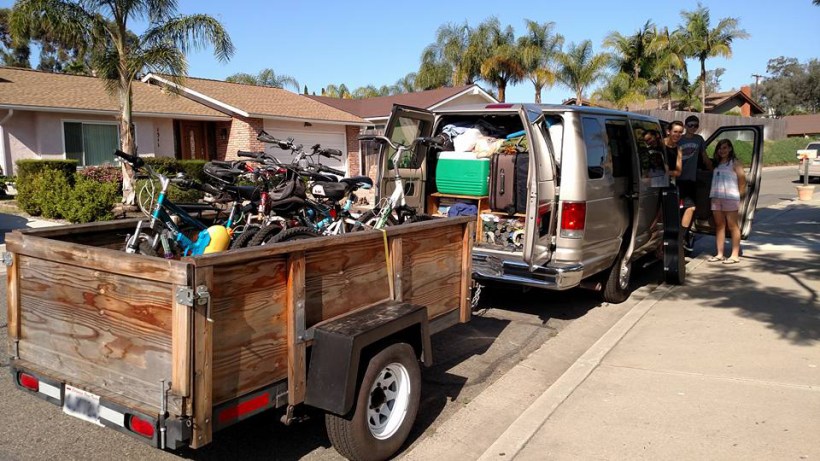
As I write this piece towards the end of June, a bit of melancholy sets in. Gone are the vacations when we packed into our fifteen-passenger van like sardines, camping gear, duffel bags, and food bins squeezed in around us, towing a trailer filled with eight bikes. In years past, I would be shopping right about now and beginning to fill Rubbermaid bins. But most of the children are grown; three are out of the house, and, of the three who are home, only the youngest isn’t working and has the summer free.

What’s left is a treasury of memories: two-day road trips to Oregon with Adventures in Odyssey and books on cassette (Elizabeth Enright was a favorite with her Gone-Away Lake, The Saturdays, and all the other books about the Melendy family); young ones piling into hotel rooms–three girls to a bed, two boys to a bed and one on the sofa; and Mike and me in an adjoining room, smiling at the silly jokes and squeals of laughter shared between siblings, which were heard from the other side of the closed door.

Bumper boats
Bumper boating with water guns on Lake of the Springs

Fortunately, we have photos to remind us of the numerous outings: boating on Bass Lake, Lake of the Springs, and Lake Oroville; sliding down spiral slides; super-soaker and bumper-boat battles; whitewater rafting trips on the Deschutes River in Bend, Oregon, and on the American River; and swimming in all kinds of pools.

I will no longer be swarmed by a band of sweaty, hungry, out-of-breath adventurers rushing into the cabin after a morning of exploring the preserve, clamoring, “What’s for lunch?” I would already have made their sandwiches, put out the chips, and placed a big bowl of cold watermelon chunks on the kitchen table. Nor will all of us again crowd into a tiny family room—four on the small sofa, the rest on the floor—watching reruns of Gilligan’s Island and The Flintstones; no more teams A and B for meals (team A would set up and B would clean), nor nightly ice-cream sundae parties, nor Fourth of July celebrations that included decorating bikes and riding in parades.

Stephen crabbing
Stephen’s Dungeness crab score!

The vacations we took weren’t elaborate; we didn’t go to exotic places or visit grand amusement parks. But what we experienced far surpassed anything money could buy. Our children had some of the best times of their lives, laughing, learning, loving, and being loved. They will forever have volumes of memories to share with one another and their children at family reunions and gatherings.

In world where there’s much focus on obtaining money and material things, I pray the example we set continues through future generations—that our children see the immense value in nurturing family relationships and keeping a balance between living a happy life and working hard, and that the material things they did without while growing up were a small price to pay for the wealth of love and experience they received.

It’s not about what we spend, where we go, how long we’re gone, or how we get there. It’s that we do it before it’s too late. I am blessed Mike and I won’t have to say, “I regret not being able to do/go (fill in the blank) while we were healthy and able to enjoy it.” Those summers involved hard work to execute, and we may not have stayed in the most luxurious accommodations, but we cherish every one of them and would do it all over again exactly the same way. I’m pretty sure our children would, too.

Our thanks always goes to God for helping us understand the importance of family and for the opportunities we’ve had to get away and refuel our tanks so we could become a closer one.

Where, O Death, Is Your Sting?

A journey into the afterlife.

That particular morning his eyes were more alert than they’d been for some time; even radiant! His demeanor was placid and very agreeable. He had reached the point of not eating much, but instead of the usual grumbling when offered a sip of water or a few spoonfuls of chocolate pudding, he simply responded, “Not just yet, thank you. Maybe in a little bit,” then he flashed a genuine smile.

Throughout the afternoon he sat in bed, not slumped over, but upright and engaged. He joked and carried on conversations. If one had not known his condition and arrived on the spot, they never would have guessed he suffered almost ten years with dementia. He was sharp and witty—just like he was when I was young.

Maybe it was the effects of the Anointing of the Sick conferred on him by our parish priest who came the night before to administer the sacrament. (In the old days they called it Last Rites.) Dad received this anointing many times during his multiple visits to the hospital in the last ten years and, oddly enough, bounced back each time. We all wondered if this would be the case in the coming days.

According to the Catechism of the Catholic Church (1520), The Anointing of the Sick is a particular gift of the Holy Spirit. The first grace of this sacrament is one of strengthening, peace and courage to overcome the difficulties that go with the condition of serious illness or the frailty of old age. This grace is a gift of the Holy Spirit, who renews trust and faith in God and strengthens against the temptations of the evil one, the temptation to discouragement and anguish in the face of death. This assistance from the Lord by the power of his Spirit is meant to lead the sick person to healing of the soul, but also of the body if such is God’s will. Furthermore, “if he has committed sins, he will be forgiven.”

Having been forgiven of any sin on his soul and refreshed with peace to dispel any fear of meeting his heavenly Father, Dad spent this day giving us his best.

The date was Tuesday, February 20, 2018. Five days before, my father was put on hospice. He was fighting a losing battle with a urinary tract infection that became resistant to antibiotics. The months preceding had been extremely difficult. Hallucinations began to appear as a result of these infections (a common symptom in seniors), and they usually occurred at night. Multiple times he would yell out in fear, and each time I’d run to his room to calm him for an hour or so before the scenario repeated.

During these wearisome times, I would often call on my dear friend and mother figure, Coleene. Not only was she a pivotal influence in forming my Catholic faith after I returned to the Church, she also worked in facilities specializing in catering to dementia patients and for many years took care of her own mom who suffered with Alzheimer’s. She was my source of knowledge and support as I learned how to deal with the onset and progression of Dad’s dementia.

Coleene passed away unexpectedly four months prior to this particular day. It was an emotional loss for me because I sought her wisdom in many things—especially those that were faith related. With hopes she was enjoying eternity in paradise, I’d often pray for her intercession during those nights sitting with Dad. “Coleene, you can see what I’m going through with him. Help me have the strength to keep this up.” Or “Coleene, I know I’m not doing this the way you taught me, but I’m so tired. Please, please, please, help me have patience!” In some small way I usually received solace and felt she was looking down on me; she knew exactly what I was going through, and I’m sure if she had the ability to help, she was doing her part.

Hospice workers say it’s common for people to rally one last time at the end of their life. That Tuesday was Dad’s day. The following morning, he was back to his distant self: eyes glassed over, unwilling to talk, and he spent the entire day sleeping.

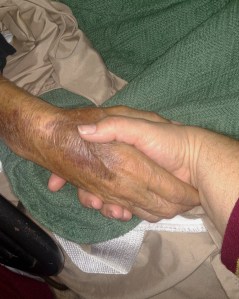
Two of his friends who are deacons in the San Diego diocese came to pray with him and bless him. Dad barely opened his eyes to acknowledge their visits, giving only a weary smile. By six o’clock that evening his breathing began to get shallow. After calling the hospice nurse, Mike and I spent the time until she arrived at his bedside on folding chairs. We prayed the rosary as Dad held my right hand.Dad's hand in mine 2

The hospice nurse arrived around eight. Dad could no longer communicate with us. His breathing deteriorated into a gurgle. I was familiar with that horrid sound as I witnessed my mother, many years earlier, die of lung cancer. His lungs began to fill with fluid, and I prayed the morphine the nurse administered made his labored breathing as painless as possible.

By 10:30, Dad had declined rapidly. I called his caregiver, Mireya, who came immediately. She’d become like another daughter to him; helping in his care for the past seven years. She stood to his left, holding his hand, as I remained to his right.

It was around midnight when I prayed one last prayer out loud and hoped Dad could hear. “Dear heavenly Father, please do not let Daddy suffer. Please take away any fear he may have of meeting you. Let him know how much you love him. Send our Blessed Mother to greet him and accompany him during this transition, and make it swift so he doesn’t have to continue in any pain. Also, make sure Daddy knows how much we all love him.”

Within minutes his breathing worsened. All of a sudden his eyes opened wide as he fixed his gaze intensely on something just above him for about one to two minutes. Shortly after closing them, he took his hands (which had been resting on the bed at his side, cradled in Mireya’s hand and mine) and brought them to his chest, holding them close to his heart, all the while squeezing as if to give us one final hug. We stood there watching.

Over the next hour, I noticed the involuntary movements his body made as it began to shut down. Every few minutes he would have a slight shift forward, his body tensed, then he’d relax. It appeared he was going through a series of contractions. Dad reminded me of a woman in childbirth.

A baby within the womb feels safe and comfortable, lulled by its mother’s voice and movements, not lacking in anything according to its understanding. It has no idea what’s beyond that space. The process of being born is arduous and traumatic. Imagine being pushed through a dark tunnel toward light that’s so bright it’s blinding.

Yet, when that child arrives into the world, it no longer must imagine the creatures from whom the voices come. It now gets to look into its parent’s eyes, see their smiles, and be met with welcoming arms, kissed, and showered with affection. The love received is tenfold what it experienced in the womb!

So it must be with death. We know only this world and like our comfortable space here. When the labor pains of death begin, we get anxious. The unknown can be terrifying. But once delivered into the afterlife, those united with Christ will be welcomed into his safe arms, showered with affection, and the love we receive will be far beyond anything we’ve experienced in this life.

In a perfect world, parents are meant to mirror the image of our heavenly Father. Through their example, their child learns of God’s love. At least, that’s the way it’s supposed to be. Unfortunately, our world isn’t perfect. Sin is present, and therefore we all fall short of being perfect examples of love. But for a time, when that newborn lies in the arms of its parents, he’s experiencing the kind of God’s utopia we hope to experience again one day in heaven.

While the movements my dad made may have upset some, they were, for me, a reminder of the beautiful world my father was soon to transition into. With each contraction, he moved a little more out of this world and into the paradise Jesus promises all those who wish to be with him.

I remember a conversation Dad and I had years after he returned to the faith. It was about heaven and hell—specifically, about his fear of dying and of not being sure what to expect. I reminded him that every day a Catholic Mass is celebrated in just about every town throughout the world. They all follow the same liturgical calendar, the same scriptures are read, the same Eucharistic celebration is offered, and the same prayers are prayed. If he were to go on vacation, or travel out of town on business, he could enter any Catholic church anywhere, and the liturgy would be the same one he’s attended in our church for years (except, of course, for nuances like the music and such).

The building might be different and the people around him unfamiliar, but the feeling of meeting Jesus at the altar and becoming one with him in Holy Communion would be familiar. I explained that the same peace, joy, and feeling of being loved he’s come to experience at Mass will be the same he’ll experience once he’s reunited with Jesus in heaven, but even better! Because he’s come to know and love the person of Jesus over the years, he’s already developed a friendship. It will be as if an old friend met you at the airport in a foreign country to help you navigate through the unfamiliar surroundings.

When we first met the person who would become our closest friend, we didn’t immediately trust them. Chances are, it took many encounters, long talks, spending quality time together, enjoying fun and exciting things, and being there for support through the hard times before you realized they were safe to trust. I’ve even had friends who, in the beginning before I got to know them, weren’t people I wanted to be around but later turned out to be some of my closest confidants.

Because I’ve spent years learning who Jesus is, and how he lived and acted, I’ve come to recognize his voice and the sense of his presence. And because of this, my image of God has changed from a stern and just ruler to that of a warm and gentle Father who knows everything about me; how my heart loves and what my mind thinks. He knows the intent behind both the good and bad I do, what passions and fears I have, and how best to motivate me or caution me from acting. And because he knows me so well, he continues to provide in all the areas where I’m in need. To be a recipient of his bounteous goodness (especially when I haven’t deserved it) is humbling. When I die, I look forward to running up to him, climbing onto his lap, giving him a hug, and thanking him for being such a generous Father!

I believe this is how God wants us to look at him; yet many don’t because either they fear him or don’t believe he’s real. Many will stand at those figurative pearly gates and choose not to enter.

At the time of our death, it’s been reported that we get to see an overview of our lives; all the good we’ve done and its ripple effects, as well as all the times we’ve made imprudent choices and how those impacted others. If we don’t have a good understanding of God’s limitless mercy, we can easily become despondent from recognizing the dirt and filth that covers our soul.

This awakening will be like arriving at a glitzy Hollywood awards show in ratty overalls covered in mud and excrement, reeking of the stench of spending days traipsing waist-deep in a septic tank. Most of us (if not all) would feel out of place and refuse to ascend the red carpet looking (and smelling) like that.

But, in his infinite mercy, God provides a place to get cleaned up before meeting Him. (We call it purgatory, which comes from the medieval Latin word purgatorium, meaning “place of cleansing.”) He knows when we are shown the filmstrip of our lives at the moment of our death, we will come to recognize how unworthy we are to share in the splendor of heaven.

Because his mercy is beyond our comprehension, and because he doesn’t want to be separated from any soul he’s created, he gives us a place to clean up from the stains of our pride, anger, greed, selfishness, licentiousness, and all those things we’ve done to separate ourselves from him. He knows we’d rather have the confidence of those celebrities exiting their cars in beautiful attire to walk the red carpet. Naturally, all of us would like to enter the royal ballroom with the dignity of princes and princesses. All that is needed is our humility, a sincere apology for our ghastly appearance, and desire to be cleaned up and be reunited with the King.

As I told Dad, there will be those who will take one look at themselves and become disheartened; they will refuse God’s generous mercy and choose not to enter heaven. He gives us that choice. There will be others whose pride is so unbending they will refuse to humble themselves before God. Sadly, they will spend eternity in a great abyss of unrelenting pain, fire, anguish, and darkness. The pity of it all is that these are the ones, who in this life, wanted most to be loved, yet they ran the farthest from the source of it.

Though there is no biblical account of what heaven will be like, one can Google “afterlife experiences,” and a plethora of stories will come up of unconnected people, throughout many generations, who have medically died and crossed over to the other side. While each person’s story is unique in detail, they all have these things in common: They experienced a place of intense beauty. The things they saw, the music they heard, and the people with whom they interacted had an indescribable brilliance. There was no sickness or pain, only joy and mutual love. Communication was strikingly clear and received with a totality of understanding. The place gave these people a sense of peace they never experienced before; so much so, they did not want to return to this world.

The other thing all their stories had in common was, once they returned to this world, their lives changed. Because they had a concrete knowledge of a heavenly realm and of God, a mother figure, and other family and friends who were present in the afterlife, they realized much in this life is insignificant. The only thing that really matters is love, and in order to have and give it in its most pure form, one must be connected to its source.

Dad and I had spoken of death many times before that day. I reminded him of the good things on the other side, including my mom, who most likely missed him since her passing in 1989, and our other friends and family members.

For years I prayed when my father’s time came, God would allow him to pass peacefully at home. I didn’t want him to be in a facility that was unfamiliar. I also didn’t want him in pain. Until that day he had very little pain. Both of my prayers were granted.

Mireya, Mike, the nurses, and I continued to watch Dad in the bedroom of our home he occupied for twenty-three years, reflecting on the memories we had with him and thanking God for all the small blessings. Upon his final breath, the nurse called his time of death, “February 22, 2018, 1:25 a.m.” It was odd how it hit me, like a bolt of lightning illuminating the room: February 22 was my friend Coleene’s birthday. I smiled. How intimately our lives (and deaths) are interwoven!

Yes, Lord, death can be a beautiful thing. Where is its sting when we have the promise of something greater? On this one year anniversary of the day my daddy returned to you, may he be smiling with my mom, Coleene, and those who live in the brilliant beauty of your heavenly kingdom. And may they all be like giddy children receiving your constant love.

Being Present

“I’m starting the movie!” Mike shouts from the family room (loud enough for those in their bedrooms to hear). “You have five minutes to finish what you’re doing and get out here”. I curl up next to him on the loveseat. The ones who want a coveted section on the sofa quickly claim their spots; the dilly dallyers who trail behind must find a niche on the floor. Everyone participates.

Our tradition of watching “It’s A Wonderful Life” on Christmas Eve began twenty-three years ago when we had our first son. During the years when the children were little, it played in the background as Mike assembled toys and I wrapped presents and filled stockings. As the children got older, we switched to watching in the afternoon. When they reached the age of being able to stay up later, we returned the viewing to evenings after Mass and Christmas Eve dinner.

In the story, George Bailey, son of a Building and Loan president, struggles with being the responsible one; caring for others while putting his life and passions on hold. At one point when his troubles became seemingly impossible to overcome, he wished he was never born.

The dejected soul was sent an angel named Clarence to show him what life would be without his existence. As it turned out, George, in his ordinary way of doing for others, made a huge impact on his town. In the end, the favor was returned many times over.

Love motivated George to care for the people around him over seeking out his own interests. By doing so, he made a positive impact that created a ripple effect for good. As Clarence showed him, had he not been born, many people’s lives would have had a negative outcome.

Years later, multitudes would have perished in the war had he not been there as a child to jump in and rescue his younger brother, Harry, from drowning in a frozen lake. Harry became a Navy pilot and shot down a Japanese plane on a mission to destroy an American troop transport ship.

A woman would have died and his boss’s life would have been destroyed had he not stepped up to point out the error after his boss mistakenly filled a prescription with poison while lamenting the shocking news of the death of his son.

George also fought for the underdog. When the hard-working people with whom he knew could not qualify to borrow money to buy a home, he felt compassion and extended them a loan so they could better themselves.

I thought about this last night as our family was once again reminded how important each one of our lives are.

How often have we thought, “I wish I was never born”? I’ve been guilty of it many times, feeling the yuck of my poor choices, rejection from others, or the weight of heavy crosses that were given to me to carry.  Sometimes, when sorrow and stress cloud our vision, we fail to see how integral our lives are to those with whom we come in contact. It’s also easy to take for granted the people who crossed our paths and made a positive difference in our lives.

George wanted to hit the world with gusto–he wanted to do great things! But it was all the small, consistent acts that made huge impacts. The everyday choices of thinking of others and being present to them was the difference between life or death, success or failure, happiness or misery.

Mary, because of her choosing to be present, caused a ripple effect that changed the world. A simple fiat–“May it be done unto me according to your word.”–brought love to us all.

Christmas is not about the decorations, lights, gifts, food, or carols. None of these were present at Christ’s birth (except, possibly, the Little Drummer Boy’s drum ditty and, of course, the light from the star that guided the Magi). Being present was. The wise men, shepherds, angels, Mary and Joseph presented themselves in awe and wonderment at the arrival of the Babe. Their presence ushered in a new beginning – a way of peace and joy.

It’s beyond my imagination to contemplate what our world would look like if Mary had not said yes; if Joseph didn’t heed the message of an angel; if the innkeeper didn’t offer the couple his humble stable; if Jesus was never born.

On this day, not only do I wish each of you a Merry Christmas (which we get to celebrate for the next twelve days–hence the twelve days of Christmas), but I pray you have eyes to see the positive impact you’ve made in the lives of others and that you never doubt the immense value of your presence in this world.

As we celebrate the birth of Love, let’s thank God for the times we chose to put our plans, dreams, and desires aside to be present for one another. And may we become encouraged to keep Christmas alive by giving our presence all year long! Who knows what kind of great things we can stir into action.


Restless Hearts

His virile body reclined next to hers, spent and satiated. He lingered until she was in a deep sleep then tenderly brushed aside a dark tendril from her cheek before placing a goodbye kiss upon the fullness of her lips.

Parting was always difficult, especially when his infant son slept not a few feet from them. It was scandalous enough the object of his desire was beneath him in social standing, but that they conceived a child out of wedlock was something he knew would crush his parents—particularly his mother, who warned him repeatedly of the dangers of promiscuity.

The handsome young man exited the small house a few hours before dawn. Sounds of merrymaking could be heard escaping the tavern down the street. He stepped in for a drink and found three friends already intoxicated, begging him to join them. A nod of the head toward the bartender and his usual was ordered and served.

Uninhibited under the influence of ardent spirits, the lad’s witty intellect and confidant stature attracted an audience. Years of reading to appease an insatiable appetite for knowledge, combined with a formidable education, gave him a wealth of worldly wisdom (and a pompous opinion), which he shared with an air of authority.

A typical evening for this sensualist ended shortly before daybreak. And each time he staggered home, his mother stood, unnoticed, praying for her wayward son.

This may sound like most twenty-something males of today, yet this one lived in Thagaste, Numidia [now Souk-Ahras, Algeria], in A.D. 374. The lad: Aurelius Augustine, more famously known as Saint Augustine of Hippo.

In my early teens, I remember my mother invoking Saint Jude’s intercession for those impossible cases, Saint Anne for all her motherly problems (specifically regarding those dealing with her wayward daughter), and Saint Anthony for help in finding things. In my eyes, these saints lived a perfect, holy, and spotless life on earth. How else could they have attained sainthood? Never would it cross my mind they were real people.

I assumed saints were given a superhuman ability to be extraordinarily good. They spent hours in prayer—in a church—with hands folded pointing to the heavens. They didn’t listen to pop music, hang around with ribald friends, drink alcohol, go dancing in clubs, fool around, smoke, or use vulgar language. In my estimation, they avoided everything I considered fun.

Early in my return to the faith, I heard the gospel reading Matthew 4:28, “So, be perfect, just as your heavenly Father is perfect.” I remember telling a mentor friend I would never come close to being perfect, no matter how hard I tried. My crimson past scarred me with too many weaknesses. Plus, I had no desire; boring wasn’t in my makeup. At most, I could be a normal Christian—one who attended church on Sundays to learn about Jesus and went around being nice to others. That was doable.

My religious friends introduced me to Saint Augustine, Doctor of the Church, and one of the most influential Church Fathers and theologians in the history of Christianity. I was given a copy of his autobiography, The Confessions of Saint Augustine, and devoured it. For someone who was born a little more than 350 years after Christ walked the earth, it amazed me at how closely his life paralleled those of today.

Augustine was born into an upper-class family. His mother, Monica, was a devout Catholic; his father, Patricius, was pagan and converted on his deathbed. Both parents put an emphasis on education and enrolled their son in rigorous courses. Born with a stubborn constitution, the saint spent most of his childhood pursuing his own interests, which most often revolved around amusement.

Monica exposed her son to Christianity, which he found intriguing in his adolescent years. The thought of a God who loved him beyond all forms of human love was comforting, and his tender soul sought, more than anything, to be loved; but he did not know how to harness that love. Instead, he went in search of all that ignited his senses, thinking love came in forms of happiness.

His passion was aroused at an early age by the sweet taste of victory; he craved a challenge in all fashions, seeking conquest, even in dishonesty. Second to his love of women, he enjoyed the folly of the stage and found theatrics amusing. Literature set his imagination aflame, which developed into a love for philosophy and writing. As he got older, his curiosity of adult pastimes paved the road to destroying his innocence. By the time he was in his late teens, he had been exposed to much of a debased world and enjoyed its indulgent pleasures.

The saint describes himself at age sixteen:

“To Carthage I came, where there sang all around me in my ears a cauldron of unholy loves. I loved not yet, yet I loved to love, and out of a deep-seated want, I hated myself for wanting not. I sought what I might love, in love with loving, and safety I hated, and a way without snares. For within me was a famine of that inward food, Thyself, my God; yet, through that famine I was not hungered; but was without all longing for incorruptible sustenance, not because filled therewith, but the more empty, the more I loathed it. For this cause my soul was sickly and full of sores, it miserably cast itself forth, desiring to be scraped by the touch of objects of sense. Yet if these had not a soul, they would not be objects of love.

“To love then, and to be beloved, was sweet to me; but more, when I obtained to enjoy the person I loved, I defiled, therefore, the spring of friendship with the filth of concupiscence, and I beclouded its brightness with the hell of lustfulness; and thus foul and unseemly, I would fain, through exceeding vanity, be fine and courtly. I fell headlong then into the love wherein I longed to be ensnared.

“And Thy faithful mercy hovered over me afar. Upon how grievous iniquities consumed I myself, pursuing a sacrilegious curiosity, that having forsaken Thee, it might bring me to the treacherous abyss, and the beguiling service of devils, to whom I sacrificed my evil actions, and in all these things Thou didst scourge me! I dared even, while Thy solemnities were celebrated within the walls of Thy Church, to desire, and to compass a business deserving death for its fruits, for which Thou scourgedst me with grievous punishments, though nothing to my fault, O Thou my exceeding mercy, my God, my refuge from those terrible destroyers, among whom I wandered with a stiff neck, withdrawing further from Thee, loving mine own ways, and not Thine; loving a vagrant liberty.”

Augustine advanced to becoming a professor of rhetoric in Carthage. Intellectual minds intrigued him and discussing philosophy provided the food that fattened his literary talent. This lured him to Manicheanism. He found its teaching of an elaborate dualistic cosmology stimulating; the struggle between a good, spiritual world of light, and an evil, material world of darkness challenged his understanding of the universe. The one thing that did not resonate was Manicheans discounted the complementary relationship between science and faith, leaving him with many unanswered questions.

Though Augustine lived a debauched lifestyle, his very being relentlessly sought to taste and embody wisdom and all her beauty. Certainly the learned and worldly minds would be the ones with explanations, so he persisted in his quest. But stubborn as he was, not wanting to subject himself to his mother’s God, he continued to suffer the anguish of interior isolation and loneliness because of his inflated pride.

One day he heard a speech given by Saint Ambrose (then Bishop of Milan). Ambrose was a professor of rhetoric at the Imperial court of Milan. It was the intellect with which he spoke—tying science and nature into the spiritual world—that made Augustine take notice. No other orator, especially those of the Manicheans, could provide the answers to the questions his mind and heart sought. As it is with truth, when we hear it, while we may not want to succumb to it, we internally recognize its validity. And so began the journey of Saint Augustine to discovering the balm that satisfied his agonizing itch.

Like Augustine, since childhood I pined to feel love at its most passionate level and searched for it in all the wrong places. Almost every word of his Confessions spoke to my core. He brilliantly, and with vivid emotion, exposed his dance with God.

“Lord, make me chaste, but not just yet.”

Such lines as, “Lord, make me chaste, but not just yet.” rung like a bell, summoning my attention. This was real! His story wasn’t about a perfect Christian. Here was a man who blissfully wallowed in sin—even having a child out of wedlock—and struggled for a long time to overcome his passions. Then, upon finding the love for which his heart ached in a heavenly Father whom he had pushed away, he became one of the most passionate lovers of Christ and a model of authentic holiness.

I did not know my Creator as an intimate lover. I knew him as a just ruler, tallying all the bad things I’ve done in my life and dolling out tragedies as a punishment. Like calligraphy on a page—carefree, swirling letters making each word beautiful, artistic, sensual, and pleasing to the eye—Augustine described a kind of love that made me envious. I thirsted to experience what he had.

I wondered if his God could truly understand my longing for affection and validation. Could he know me so intimately to understand why I turned to sin? And could he possibly, as Augustine boasted, show the greatest mercy by wiping my slate clean—infinite times—because he knows how weak I am?

Many today can relate to the twenty-something person I described earlier. We search for ways to feel pleasure, thinking this must be the way to happiness. Yet, after the crescendo comes, the alcohol no longer satiates, the drug wears off, the wins have all been gambled away, or the over-dedication to work destroys our families and friendships, there is always a void.

Deprivation of love has been a source of much misery in lives. We’ve been created with a hunger for the kind of relationship with God of which Augustine speaks, but our appetite, placated by paltry imitations and preservatives, has, instead, left us malnourished by the unhealthy calories of spiritual fast food. The delectable, robust flavors and intricate textures of a nutrient-rich banquet meant to fuel us and excite all our senses have been (on the contrary) viewed as unattainable and left for an elite few. We don’t realize that choice banquet is meant for all of us to enjoy!

I grew up vying for my father’s attention. My dad was a wonderful man and taught me much, but he lacked warmth. I attribute many of the insecurity issues I’ve had with men to our relationship. As a young child, I often wanted to curl up on his lap and feel the assurance of his strong arms protecting me. But he wasn’t like that. At most I got a ten-second embrace, followed by a pat on the back, as if he were meeting a buddy at a ballgame.

When I became a teen and got dressed up for an occasion, instead of a compliment, there was usually a sarcastic joke about a tomboy wearing heels. Sarcasm was the defense mechanism he used to dodge emotion.

As an adult working extra hard to accomplish a goal—thinking for sure he’d be impressed—I got a smile and nod of the head. It was my mother who provided the hugs and accolades for my successes.

I now understand my father’s lack of warmth and affection stemmed from his own pain. His mother died when he was fourteen. Soon after, his father sent him to Canada, telling him his aunt could care for him since he was his mother’s child. The young boy convinced himself he must have contributed to his mother’s demise and deemed himself rotten. Feelings of abandonment and betrayal put in motion a life shadowed by self-reproach, which eventually built a wall to protect his heart.

We cannot give what we do not have. My father was incapable of giving me the affection and affirmation I sought because he was never taught how. So often is the case with people today. They are quick to blame others when left unfulfilled, yet if those from whom they seek do not have that which they seek, they will always be left disappointed.

Was Augustine raised by a mother who was cold and indifferent to affection? Did he have a father who could never please his own dad and thus passed on those fears to his son? Did his parents show love with rigidity and rules, lacking in warmth, thinking this was good parenting? Or, could his parents have been so wealthy they appeased him with material gifts instead of giving him time and personal attention?

None of us have perfect parents, but we must give them credit for the all the good they’ve done, knowing they did their best. Like them, we too likely wounded our own children with our hidden pain and insecurities. Just as we hope our children will be compassionate toward us for our parenting failures, we owe our parents that same compassion.

Almost twenty-five years have passed since I was introduced to our sinner who became a saint. I’ve read Confessions at least a half dozen times; each time finding more wisdom buried in those beautifully written words. Eventually the burning love of Augustine’s God seared my heart. Years of resisting him, years of anger for having to endure the tragedies placed on my path, years of searching in all the wrong places rendered me humble and grateful for his tenacity.

My heart wants to burst at times. This kind of joy cannot be found in human interaction. We are too beat up and bruised to love in this way. It’s unfair to look to others for the fulfillment of our needs when some of them can be fulfilled only by the One who knows how to love without limit and has the omnipotence to know precisely what makes us happy. And he does!

Figuratively, I am often I focused on wanting a chocolate chip cookie, but will hear, “No, Robin. Hold off. I have something better.” When I obey in abstaining from the cookie, placing my trust in him, I always end up with a three-layer chocolate cake, filled with decadent butter-cream and topped with shaved dark chocolate (which is a big upgrade for me). Our Lord is never outdone in generosity. I’ve come to realize the more I give up the flashy baubles that excite my attention and allow him to gift me with his will, the greater the gem I receive.

God never gives up on anyone, even the most hopeless—which is why we shouldn’t either. He waits patiently, sometimes putting people on our path to shower us with his love and mercy, pray for us, and fast for our return to his outstretched arms. It’s those people for whom I’m most thankful in my life, because without them I would not have what I do today.

It took a steadfast woman seventeen years to win the soul of her wayward son. Not only were her prayers efficacious in his abandonment of his sinful ways, but they were instrumental in him becoming a model of righteousness for others.

Both were needed in God’s greater plan: In order to become an amazing saint and teacher, Augustine needed to be a grandiose sinner. And Monica was needed to be the example of perseverance in never giving up praying for those who are broken. This should give even the worst sinners hope as well as those who pray for them.

My image of a saint has changed throughout the years. I no longer envision a perfect person, always doing the right thing (because even those types struggle in hidden ways). No. I believe a saint is a sinner like all of us, who recognizes their nature, falls, gets up, and keeps trying—endless times—out of a desire to grow closer in an intimate relationship with our Heavenly Father.

I also no longer look at saints as boring. Many of them did their own share of hell-raising, had big personalities, and stubborn constitutions. The difference between them and us is they discovered the secret to having joy. The more courageous we are in allowing God into our hearts, the less we seek an imitation of happiness because we become saturated with authentic love; the thing for which we are all looking.

Yes, Saint Augustine, in your words relating to God, “… our hearts are restless until they rest in you.”


Connecting With Music: An Elixir for Life!

The savory fragrance of garlic and onions sauteing in olive oil perfumed the air while Dean Martin’s Sway and Rosemary Clooney’s Mambo Italiano (among others) ignited impromptu twirling around the kitchen.

It was not unusual for my mother to grab my hand between frying meatballs and lead me in circles as we laughed and made fools of ourselves. This image, synonymous with cooking alongside her, ingrained an indelible memory-an expression of love I later adopted with my own children. Not only were my mother’s meals a reason to celebrate within themselves, but making them with her was part of the experience, and the tunes to which we lovingly prepared them were as well. Music was a large component of her secret recipe for life.

My appreciation for this potent ingredient blossomed in June of 1976, when I celebrated one of my more magical birthdays. I received invisible wings that year in the appearance of a new Huffy bike: lime green with a white banana seat and telescoping handlebars. Accompanying it was a little transistor radio with a wrist loop through which I threaded one of the handlebars so tunes could accompany me everywhere. It was the summer of newfound independence, connecting people and places with song.

In those days, my friends and I bolted out the front door around eight-thirty in the morning and didn’t return until after dark (except for quick stops to refuel with lunch and dinner). We’d either cruise the neighborhood on our bikes, taking turns passing around the tiny sound box, or sit crisscross-applesauce in makeshift forts, listening to tunes while sharing the grandiose dreams and deepest secrets of bright-eyed ten-year-olds.

Lunch may have filled our tummies, but we feasted on the auditory delights of Peter Frampton, The Bay City Rollers, Paul Simon, ELO, K.C. and the Sunshine Band, The Bee Gees, Dr. Hook, and Wings, to recall a few. We discovered this addition to our time of play heightened creativity and added a new dimension to associating a memory, thus bonding our friendships on a different level.

Two years later, my family relocated to a new state, which meant a new neighborhood, a new school, and having to make new friends. Every sixth-grader can attest, this is never an easy task. Damned be puberty when our bodies take on new shapes and hormones turn once carefree children into awkward adolescents.

Taking a cue from my mother’s friend-making talent (entertaining), I held a party in our detached garage and invited the neighborhood kids. Industrial shelving lining the perimeter of the walls was concealed behind large sheets of decorated bulletin board paper. Mowers, bikes, and other items usually taking up residence in the space were temporarily relocated behind the building and out of sight. The concrete floor was swept and hosed down. All semblance of the former area was masqueraded into a dance hall.

A few black lights with their mesmerizing purple halos were purchased to set aglow any white embellishments on our clothing amid the pitch of the dark. They replaced standard bulbs in the sockets above the workbench, which was converted into a DJ station where my stereo and speakers had been carefully relocated from my bedroom.

Forty-fives of collected top hits and LP’s purchased at music stores and obtained through a year-old Columbia House Records subscription were stacked close by. (What teen back then didn’t begin their collection by purchasing thirteen albums for just a penny?)

It was the age of innocence. Learning to socialize outside of a classroom with someone of the opposite sex was disconcerting. My mother’s infamous Pepperoni Bread and Italian cookies were a good ice-breaker, though it was the music, again, that broke down barriers, paving the way for a bunch of gawky youths to forge new friendships.

Lyrics became an unspoken language, providing the words we were too shy to speak and conveying feelings we were too embarrassed to share. Songs began harnessing a magical energy for developing relationships and were the means for collaborative conversations that segued into a host of social opportunities: visits to friends’ homes, cruising in the car, concerts, and days spent at the river or the beach. One no longer felt as though they were a loner, but rather a part of something. You belonged.

One of the highlights of my young adulthood was graduation beach week. Not so much for all the shenanigans that took place, but for the camaraderie forged. I can still picture our swimsuit-clad group descending the narrow stairwell from the third floor of the old beach house we rented, Birkenstocks thumping on the wooden steps.

As we exited the building, the intense sunlight of the eleven o’clock hour greeted us. One of the guys – in true Manfred Mann style – belted out, “Blinded by the light”. The other eight of us chimed in, “Revved up like a deuce, another runner in the night.” It was a spontaneous response by those sharing common musical tastes. To me it was tantamount to the kindred feeling you get when someone who knows you well finishes your sentences in an unspoken union of spirit.

Days that week were spent on the sand; our towels and blankets making one huge patchwork quilt. As we girls worked on our Bain de Soleil, San Tropez Tans, the guys dialed the boom box to Z-104. Unlike the kids of today who are attached to their private earbuds, sharing music was a main component of our beach experience. As we lazily basked with oiled skin, upon hearing the first four notes of a mutual favorite tune, we’d instinctively pop up and belt out lyrics while torso dancing in synchronized gyrations. It was as though we all simultaneously received an injection of pure adrenaline.

Studies have shown that sharing music, because of the energy it ignites in us, increases our feel-good hormones. Serotonin, the “happy hormone” is released, which regulates mood and keeps depression and anxiety in check. Endorphins are generated, which are the hormones produced after exertion and those responsible for keeping physical pain under bay.  These are also the ones that kick in when you feel lightheaded or giddy.

The greatest ingredient in this feel-good cocktail is oxytocin. Oxytocin is the hormone responsible for developing trust, compassion, and influencing human connection. It’s the “comfort” hormone that helps us draw close to others and is stimulated when we share like-minded thoughts, activities, and beliefs. It affects our feelings of being loved, understood, and appreciated.

When we listen to music, especially within a group, our brains tune into the fact that we are feeling pleasure-the pleasure of the sounds and experiences, as well as the feeling of being connected to others.

Then there is dopamine, the “reward” hormone. When we listen to music, especially within a group, our brains tune into the fact that we are feeling pleasure-the pleasure of the sounds and experiences, as well as the feeling of being connected to others-thus giving us a desire to want more.

During World War II, USO dances were the respite for weary servicemen and provided a way for women on the home front to feel as though they were helping in the war effort. It was the ticket to maintaining sanity during a time when morale was at an all-time low and the simple comforts of living were virtually non-existent. People sacrificed at a bare-bones level with the rationing of food, gas, and clothing.

Despite dreary times, dance halls were transformed into make-believe worlds on par with the glamor of Hollywood. Wood floors were brilliantly polished or shiny linoleum squares glued over concrete. Festive decorations adorned the atmosphere, along with charming hostesses presenting themselves in their finest dresses, lipstick, and high heels, awaiting men decked out in dapper uniforms. Live bands delighted the crowds with rousing tendril-like sounds, vining around the waists of dancers and drawing them to the floor. For at least a night, people could forget about the misery, austerity, and danger of the war and become recipients of renewed energy.

This kind of morale boost not only gave the fellas a bit of R & R, but it also provided a connection to those women for whom they took personally the responsibility of protecting and returned with vigor to win the war for their country.

In 1979, Sony released the first Walkman, meshing the convenience of a transistor radio with a way to play cassettes while listening through earbuds. This escape to our own Private Idaho (the B-52’s) was the best thing to come along since sliced bread! Or was it?

These days, people are quick to handle their distress by “plugging in.” They cope by being fed intracranially through wires affixed to some kind of music source and retreating from the world in isolation, similar to that of a sick person hooked up to an IV glucose drip, seeking energy.  Sugar water can keep a sick person alive, but it provides little nutritional sustainability for long-term health and vitality.  Sometimes it’s necessary to take emergency measures when we’ve become depleted. It is possible to survive like this for short periods of time, still, the body requires more.

Our nature was created for community and doesn’t function at optimum efficiency as an island. The human condition thrives on social connection. Research concludes, time and again, that those who feel a connection with others are happier, more secure, well-adjusted, and have lower rates of anxiety and depression. They also exhibit higher self-esteem and a greater capacity for empathy.

We live in a time where there’s a noticeable decline in emotional well-being. This seems to coincide with a decrease in social interaction: a growing lack of trust and communication is exhibited by fewer genuine friendships and an increase in facades and fake personalities.

Even when people are physically present with one another, connections are not being forged due to the constant engrossment in selfies, social media, and electronic games. Young people today are being robbed of knowing what it’s like to form authentic friendships and have become more depressed than ever. The focus is on presenting the perfect version of themselves to the world, yet they guard who they really are for fear of rejection. Instead, they plug along in a fantasy world that doesn’t fulfill their aching desire to belong.

Gone are the days of heading to a trusted confidant’s house and listening to music while hashing out problems or having someone join in the celebration of good news. We had songs that fit every circumstance, and sharing them was part of the experience of life. Now people pay big bucks to therapists and are put on medications to replace the feel-good hormones we’ve been lax in producing while trying to live on our island.

Maybe there really is something to this simple remedy.  Maybe we need to make the effort to swim ashore and commune with others now and then to remind us that we belong to something and that someone else gets us and cares. We need to detach from our wires, open up our minds (and eyes) to what’s around us, and become a part of it.

At the age of twenty-three, I went through the tragedy of losing my mother to cancer. This was also during a time in my life when I frequented nightclubs with friends. I wasn’t aware of the science backing the benefits attributed to sharing music; I only knew it was the only thing that kept my head above water when life was crumbling around me. I can relate to how USO Dance Halls got those soldiers through their dark days fighting the war.

While I no longer go clubbing, I still call friends to join me for a drive to listen to music, chair dance, and sing like complete fools at the tops of our lungs, between having hearts to hearts. No drug compares with the anti-pain responses-both physically and emotionally-that bonding over music provides. The medley of camaraderie, jokes, songs, and sharing of stories is like a precious drop of water from the Fountain of Youth-an elixir of life!

Not long ago, my son resurrected my first record player: an old Sharp Stereo Music Center, and with it, many of the LP’s I’ve collected over the years. Included were some of my parents’ albums, reminding me of extended family holidays, their block parties with neighbors, weddings, and gatherings from my youth. I may not remember the particulars of the occasions, but I remember the people, some of the stories, most of the music, and the joyous feeling of being a part of something wonderful.

Often I will reconnect with a person from my past and a song we shared will be brought up. Immediately an old connection is reinforced and the feeling of comfort transcends time, like that of slipping into a pair of favorite broken-in jeans. There’s no pretense, no fuss, or stiffness; no need to look impressive. It’s easy, relaxed, and real. And just plain good!

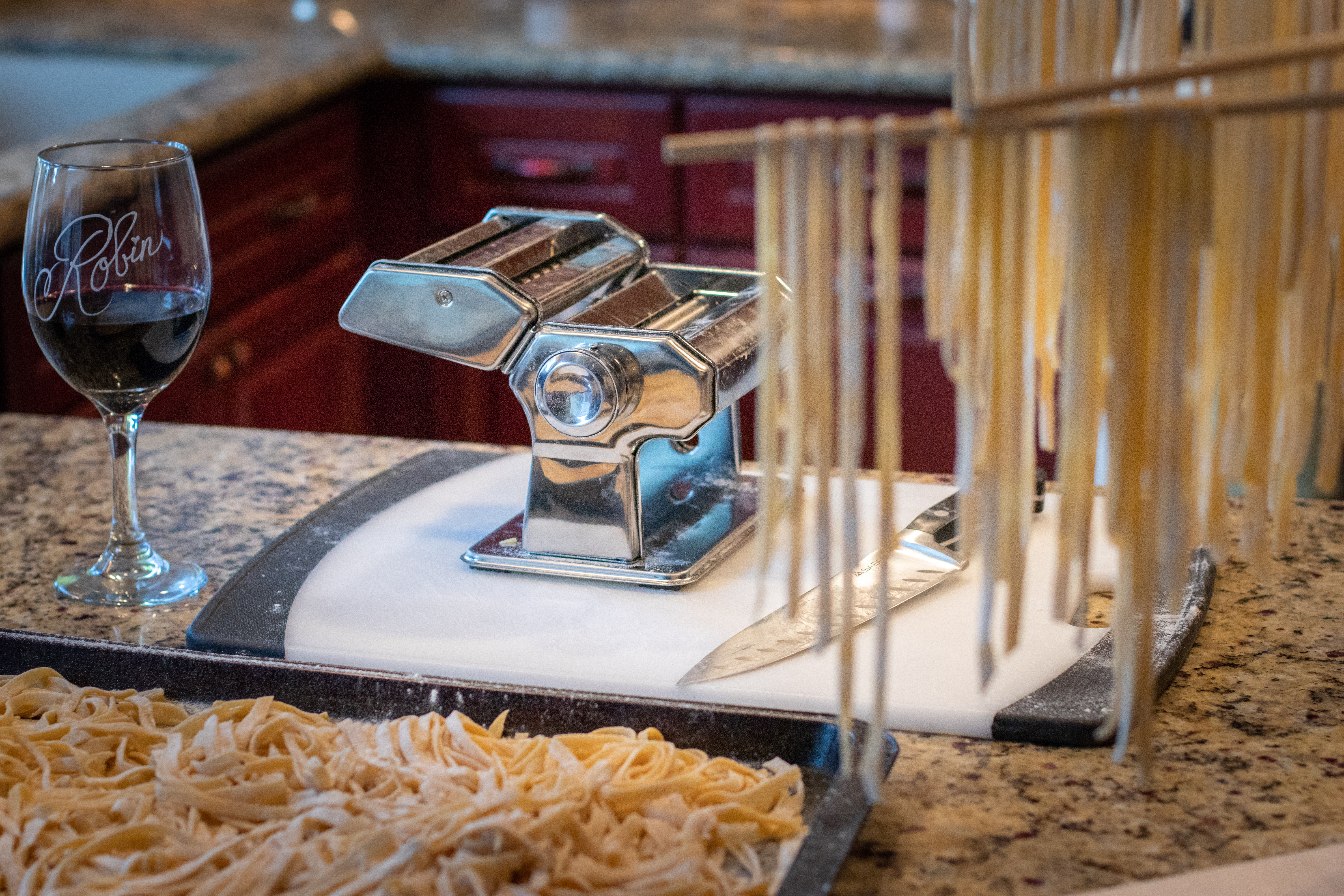
On a recent Sunday, I brought up my Robin’s Cooking Playlist on YouTube, poured a glass of wine, and then drizzled a little oil into my sauce pot. I added onions and garlic to saute, and pulled out the pasta maker. Shortly thereafter, a few of my children (now in their 20’s) came into the kitchen to see if they could help. With each of us, hands covered in flour, taking turns feeding the dough into the press while Dean Martin played in the background, I smiled and mused, “I hope my family-and others who have shared this experience in my kitchen-never forget they belong to something wonderful.”

passta
That’s Amore!

Dump The Dirty Water

“God means to fill each of you with what is good, so cast out what is bad! If He wishes to fill you with honey and you are full of sour wine, where is the honey to go? The vessel must be emptied of its contents and then cleansed.” — St. Augustine of Hippo

Recently I had a conversation with two friends who were lamenting all the misery in their lives — years of struggles consumed them. They couldn’t seem to get their heads above water no matter what they did. Tired of it all, they longed for a magic formula to change their lot.

Both are people with whom I generally refrain from discussing religion, because I know it makes them uncomfortable. But this day it was impossible for me to keep silent. It’s agonizing seeing others go through tough times, especially when you’ve been in their shoes. What’s more difficult is to have found a way to rise above and then be expected to hold back from sharing the secret of your success.

I told the two they weren’t going to like my advice, but I promised it was as close to a magic formula as they were going to get. “Surrender,” I said. I owe every bit of what I have — material blessings, a wonderful husband, six great kids, good health, amazing friendships, peace and happiness — to the fact I’ve struggled against self and allowed God’s will to prevail. I tried to explain that we remain unhappy and frustrated when we insist on things God sees as not being ultimately good for us. (Because he knows what makes us happy and can see things we don’t.)

I’ve insisted on my will most of my young adult life. Unfortunately, I come from a bloodline of stubborn pride. Yes, Italians can cook like nobody’s business, love with passion unleashed, and embrace all things beautiful; but our biggest downfall is our deep-seated pride. Plainly, we don’t like people telling us what to do — but, then again, who does? Pride is the one thing that most gets in the way of God’s plan for our ultimate prosperity.

Reaching the point of realizing we are not in control is a difficult process. We want to think we are, and we’ll just about kill ourselves to prove it, but we really aren’t. When I finally figured out my will was no match against God and surrendered my way in order to do things his way, the frustration turned into joy, and my life began to be blessed with many wonderful things.

God often allows our free will to bring us to the point of being in such a big mess that we have no other choice than to turn to him. He can, and will, fix all of the tattered fringes of our screw-ups and somehow weave them into a most beautiful garment — if we allow him.

Lent is a perfect time to begin again. One of the most wonderful things we have as Catholics is the sacrament of reconciliation, also referred to as confession. Here we can empty and scrub out the vessel of our soul to make room for Our Lord. At our baptism we were marked as sons and daughters of God. Our souls were washed clean of original sin, made pure, and filled with the light of Christ.

Our Protestant brothers and sisters also acknowledge the beauty of baptism and rejoice in washing the soul clean. But unlike them, left to carry the sins they make after being baptized, we have recourse to the sacrament of reconciliation, which gives us the opportunity to once again be reconciled with God and return to that same state of grace given to us in our baptism. And we have this opportunity available to us as often as we need or desire it.

Unfortunately, this sacrament often gets a bad rap. Many old-time Catholics have memories of going to confession with stern priests who made them feel so awful they decided not to go back. Some don’t go because they are afraid God will ask too much of them — afraid that if they admit to a sin, they’ll have to give it up and miss out on something they think God couldn’t possibly replace with something better. Others refuse to believe they are real sinners and think they don’t need to go. Still others decide not to air their dirty laundry to anyone, not even the one person who, acting in the place of Christ, can relieve them of the agony of carrying that ugly load. It’s too bad, because this gift is meant for our benefit and, if taken advantage of regularly, is a source of joy.

When my children were young, I never wanted them to feel that confession was about reminding them how bad they were. I wanted them to look at it as an opportunity for having another chance to get it right: a clean slate with God. I took them out in the backyard with one of my glass vases and explained how our soul can be likened to a vase.

GlassAt baptism our soul is filled with sanctifying grace, the kind that lives in us and unites us to God’s will. I filled the vase with clean water to signify being filled with his grace. Taking a flashlight, I put it against the glass to show how the light reflects through and out the other side, spilling into the surrounding area. I explained that Christ is the light we receive at baptism and we, like the vase filled with pristine water, are made to reflect his light onto others, dispelling the darkness of this world. This is the mission of every Christian.
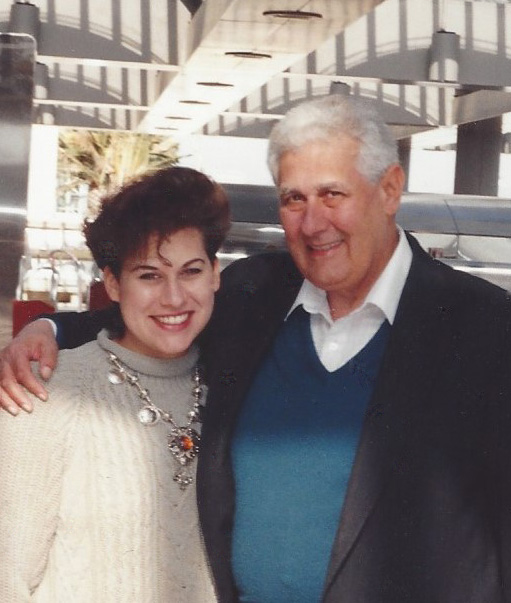

But we are human. And in our humanness, we sin — a lot. We are selfish and don’t always want God’s way; we want ours, which, little by little, diminishes the grace needed to be in union with him.

If we continually told our best friend we don’t want or need his help and advice and to go away, would he want to hang around? Not mine. He’d tire of me not heeding his good counsel as I continued to complain about wallowing in my mess and eventually leave me in my pride to fend for myself. In order to maintain a close friendship, we need to be open to the wisdom of those who care about us and careful not to sever ties. If, now and then, we hurt our friend, we should be eager to apologize and show him how much we love him by being a better friend. It’s no different with our relationship with God.

I explained to the children all of our sins can be compared to dirt. I gave each of them a spoon and told them to scoop up some dirt and empty it into the water. Whenever we sin, it’s like taking a spoonful of dirt and sprinkling it into the vase filled with crystal-clear water.

Some sins are a teaspoonful: those times when we get angry or lose patience; when we’re lazy, complain, or choose not to do the things we know we should be doing. They are small acts of selfishness. Others are a tablespoonful: things like lying, cheating, or causing others emotional or physical pain. These are the kind of sins that clearly show our lack of obedience, love, and respect for those around us.

And there are the serving-spoonfuls: These are the serious sins. We call them mortal sins because they separate us from the love of God by cutting off the umbilical cord of grace. Three things need to be present for a sin to be of this caliber: 1) The matter must be grave. 2) The person committing the sin must have full knowledge of the immorality or evil involved in it. 3) He or she must willingly consent to commit it. These sins include murder, rape, incest, perjury, adultery, and of the like. In a sense, these sins are the kind where we blatantly say, “No, God! I will not serve you!” At this point we have walked away from sanctifying grace by our own accord and, in a sense, have undergone a spiritual death. We have told God we don’t want his help or his ways, and we are our own master.

As the children emptied their spoons into the water, they watched it grow cloudier with each spoonful. The more that was added, the less the light was reflected. I explained that the teaspoon and tablespoonfuls, over time, could eventually make that water pretty murky, and the light would have a harder time shining through, which meant others would have a difficult time seeing the Jesus in our souls. Eventually, they could see the light from the flashlight was only a small spot on the glass with no reflective properties at all.

Finally, they dumped the serving-spoonful in the water, and it turned the whole thing into a big clump of mud. Applying the flashlight again to the glass, we could not see any of the light whatsoever. The children, wide-eyed asked, “What happens if we get mud? Will we never be able to have Jesus shine in us again?” I smiled.

God knew when he created us that we would refuse him on many levels. He knew in our ignorance of his master plan and in our lack of trust we would want to take control, and in doing so would be the cause of our own unhappiness. This is why he gave us the sacrament of reconciliation — so we can be reconciled with Love over and over again.

I flipped over the vase, took a spoon and scooped out all the dirt. I told the children this is what happens when we go to confession. We empty out all the yuck — even the mud! Then I grabbed a towel, scrubbed out the residue, and made the vase clean again. This represented the words of the priest when he tells us our sins have been forgiven. Finally, I filled the vase back up with fresh water and told them this is how our souls looks after confession. We are filled again with sanctifying grace, reunited with the love of God and able to share that love and light with others.

Because of this childhood lesson, our kids have grown to have a healthy view of being right with God. They’ve come to love this sacrament, and they understand how good it feels to get a clean slate and begin again. They recognize when they are in the state of grace, it’s easier to make better decisions, avoid temptation, and follow God’s plan. And the reward for their humility and obedience — blessings galore!

Here’s where St. Augustine’s quote comes in. If we want God to reside in us — if we want to allow his will to take us on a path to happiness and joy — we need to clean out the mud that takes up space in the vessel of our soul. How can we expect Christ to want to be present if we are living in a space occupied by things offensive to him? We wouldn’t want to live in a house packed to the ceiling with dirt, feces, garbage, and all kinds of defilement, yet we somehow think that kind of a home is befitting of the King of Kings! When you love someone, you give them your best. If we’ve invited Jesus to live within us, we should do our best to make his home worthy of his presence.

During this time of Lent, we are reminded of our lot by the ashes we received on our foreheads on Ash Wednesday. This is an outward sign of our coming to the realization that we are not in control. The fasting and bumped-up efforts to be there for others have a twofold effect: they give us an opportunity to let go of the attachments we have to worldly things — those things that often lead us into sin and weigh us down — and they shift our focus to reliance on Christ, uniting us to his suffering so that our capacity to love increases.

Our Lord does not want us living in the misery we bring upon ourselves. He doesn’t want us breaking that umbilical cord of sanctifying grace, because he has so much more in store for us than our paltry, selfish ways of feeling good. He wants us truly happy, at peace, and filled with honey!

As for my friends, I shared the Scripture passage revealed to me years ago when I could not get my head above water: “For I know well the plans I have in mind for you, plans for your welfare and not for woe, so as to give you a future of hope. When you call me, and come and pray to me, I will listen to you. When you look for me, you will find me. Yes, when you seek me with all your heart, I will let you find me and I will change your lot.” — Jeremiah 29:11-14.

I asked them to trust me. This was the magic formula that changed my lot. Seek him with all your heart. His generosity cannot be outdone.

Easter is the time of new beginning and new life. Lent gives us an opportunity to prepare for this new beginning by making the effort to reconcile with God, especially if we’ve got mud in our vase. It’s the time to relinquish control, give up the pride — especially if life seems extra hard right now — and clean out our vessels, giving it our all to put aside self and seek him.

If at Easter you have a smile on your face and peace in your heart, and blessings begin to fall into place, don’t thank me. Thank Our Lord, because it’s him, not me, calling you.

I Don’t Remember Mama Saying There’ll Be Days Like This

To know someone shares the weight of your cross gives strength to persevere.

With the creamy freshness of Ghirardelli peppermint bark lingering on taste buds and decorations neatly packed in their Rubbermaid containers and returned to the attic, I began the descent from the heights of Christmas back to the banality of everyday living.

A month of dust has been Swiffered from surfaces where angel figurines danced and wise men trod. Celebratory meals were added to the treasury of fond memories, as were the festive moments spent with guests. Stale cookies and leftover candy found their way into the trash in anticipation of the renewed commitment to healthy eating. College-age children departed back to school, and my quiet house once again echoes with the unwelcome reminder that youth is fleeting.

The week ahead is already peppered with doctor appointments in between caring for my live-in, eighty-nine-year-old father, helping my mother-in-law make arrangements for her recently deceased husband, keeping up with a coffee business, and whatever else my husband and children throw at me. I sit in front of a mirror, dispirited, because the reflection clamors, “Please take care of me!” But I don’t have the energy, nor do I have the desire. For the moment, I’d like to pull the covers over my head and hibernate like a bear in winter.

My mother warned me there would be hard days, days where I’d have to buck up, put a smile on my face, and plow through the storm. She also reminded me storms were infrequent and, although some could last days or weeks, most only lasted an afternoon or evening. I grew up having the foresight to look beyond the clouds and anticipate what was on the other side of the rainbow. But what happens when that kind of vision gets dulled, when it becomes harder to make out the rainbow because the clouds are so dense?

Caregivers out there can relate: mothers who live on four hours of sleep a night and manage to run a household; those who care for the sick, disabled, or elderly; and those who professionally oversee the health and welfare of others. We generally don’t get time off for the holidays; if anything, we work harder in order to give others time off.

This year has been particularly difficult. Perhaps it’s due to my progression in age and waning patience. For nearly ten years I’ve cared for my father as he progresses through stages of dementia.

Dad came to live with Mike and me shortly after we were married. He was here for the birth of all of our children. Six in eight years was a handful, and his help was greatly appreciated: he taxied them to and from school, did light housecleaning, and ran errands. He even worked part-time and contributed to the food budget. We have always been close, and I enjoyed having him around.

Now he’s become a helpless child, unable to do the simplest of things on his own. And while Mike and I dreamed of the day when the children were old enough to be self-sufficient so we could take a deep breath and enjoy a slower pace, we’ve found this stage in our life in some ways is more exhausting than when the children were little.

At seventeen I made a vow to care for my parents in their old age, come hell or high water. It was then that I attended cosmetology school, where seniors from a local nursing home were bused in once a week to have their hair and nails done. These men and women lit up when they arrived, delighted to be among faces who would extend a smile or the slightest gesture of affection. Many of them said they no longer got visits from family members. Most of them lacked proper hygiene, and it was clear to me they were victims of neglect in many ways. The emotional impact of seeing those people was so strong I wrote on my heart that as long as I was physically capable of caring for my parents, they’d never be put in one of those places.

Dad and I 1991 c
My hero, 1991

I’ve spent a decade toileting, showering, dressing, feeding, and caring for the needs of a man who was once my hero; a man who rescued me from multiple calamitous plights, made me believe I could accomplish anything I put my mind to, taught me many life lessons, and was my partner in business, my trusted confidant, my friend.

I’d like to say I take on this job valiantly, but I don’t. These long years have taken their toll. It’s one thing to care for someone’s physical needs—I can handle hard work—but it’s another to endure the emotional stress of dealing with the shell of a man, void of anything he once was, and being called to love him in his most unlovable state. Some days after having to repeat statements over and over again only to be met with a blank stare, or having to get up in the middle of the night two and three times to find continued inquiries to his distress yield no cause—nor a solution, for that matter—would push the boundaries of even the most patient person.

Even with the mantras of “God never gives us more than we can handle,” “I can do all things in Him who strengthens me,” and my ever-present “Jesus, I trust in you,” and with faith in knowing I’m doing the right thing for my father—with a spirit of mortification, offering it up for a person or circumstance, and plunking pebbles into my sacrifice jar—there comes a limit. I reach the point of utter fatigue, lose focus, and am left without an ounce of energy to keep the broad beam of that cross squarely set across my shoulders.

Many of my friends are in the same boat these days. Where we once conversed about being up all night with babies, it’s now shared stories of the strange effects urinary tract infections have on the aged. Their hallucinations at first seemed comical. I used to wonder where in the world my father came up with some of his material. But after a few bizarre wee-hour conversations about hockey players waiting for my husband to buy skates, or having to get up on deck because he’s on duty, it gets tiring.

I don’t remember my mother telling me there will be days like this. She didn’t mention there could be years in which I’d have to care for my father in ways only nurses should be entrusted to do, nor did she prepare me for the mental baggage that went along with it. No, this is one of those things I’ve had to learn on a day-to-day basis.

Many days I fail, as do my friends. I’m here to say it’s okay. It’s okay that we can’t always be patient, loving, and kind. It’s a hard job. When we fall short, we apologize, dust off, and begin again. A friend said to me one day I was having a meltdown, as she passed a box of Kleenex (I’ve been through a few over the years), “It’s good to cry and let it out; just do it as we’re moving forward.” The key words here are “we’re” and “moving forward.”

Let’s start with “we’re.” I’m not alone; I have a companion in my suffering. When Jesus was experiencing his agony in the Garden of Gethsemane, he sought the company of his confidants. In his humanity, he wanted his friends to be there for him. “My soul is sorrowful even to death. Remain here and keep watch with me” (Mt 26:38).  Notice, he didn’t ask them to fix his problem. Who could fix Jesus’ problem? He asked them to be with him. Like us, he didn’t want to endure the suffering alone. He wanted those in whom he trusted to give him their time and presence. It’s not always about finding a solution; it’s about the support.

Skip to Calvary. Jesus was capable of anything. He was God. Why then did he need Simon the Cyrenian to help carry the cross the last leg of his mission? Without Simon, he would not have been able to move forward. Jesus shows us that companions are important on the journey, and not every cross is meant to be carried alone.

Jesus also gives us the example of humility. He could have said, “Nope, nope. I don’t need Simon. I got this. It may take me forever to get there, but I can do it myself.” But he didn’t. In humility he allowed someone to help him, showing us we must do the same.

Sometimes I need to be reminded I’m not Superwoman. I like helping others but have a hard time asking them for help. I’m conditioned into thinking, “I’ve got this.” Once in confession, after I shared my struggle with anger, patience, and lack of love, the priest asked if I thought maybe I was letting my pride get in the way of asking for help. Pride is thinking we can overcome something ourselves because we don’t want to impose on anyone (so I was told in no uncertain terms.)  Authentic humility, which is most pleasing to God, is recognizing we need to ask for assistance because we can’t do it alone. We weren’t designed to do it alone; we were created for community.

A few months ago I was with a friend, and the song “Lean on Me” by Bill Withers came on the radio as we were driving in the car. I started belting out the words.

Lean on me, when you’re not strong
And I’ll be your friend
I’ll help you carry on
For it won’t be long
‘Til I’m gonna need
Somebody to lean on

I relate to being the strong one in this song, the one to always offer a sturdy shoulder. But last week when I heard it again in the car alone, reality hit. It was now I who needed somebody to lean on. It was a day when I wanted to get away from it all. Responsibilities were compounded, the lack of sleep was gnawing at me, frustration was high not knowing how to deal with dad, the death of my father-in-law loomed, the pings of all the different demands and situations with Mike and the children — I was done with care-giving. I was done with all my responsibilities, and I was done with being the cheerleader and encourager. I felt like a hypocrite. I’m usually the one who reminds people to be hopeful, to offer their struggles for someone in need, to love with sacrifice, and put self aside, yet I was physically, mentally, and emotionally done! I wanted to give up. It took an hour of mindlessly driving north on Interstate 5 before I reached for the phone. I knew I couldn’t navigate this one by myself.

I have a triad of trusted confidants. and while I try to put on a smile and hide my pain from the world (including Mike and my family so I can be their positive force), these folks generally know when I’m hurting. I didn’t want them to fix my situation because right now there is no fix. I just wanted them to walk with me in my suffering.

When Jesus returned to his disciples, he found them asleep. He said to Peter, “So you could not keep watch with me for one hour? Watch and pray that you may not undergo the test. The spirit is willing, but the flesh is weak.” (Mt 26: 40-41). Jesus asked his disciples to be with him and to pray. When I walk with someone who is suffering, I do it on my knees because I know there is merit in loving with sacrifice. Jesus, again, is our example. He shows us the way we help our suffering friends is to put our comfort aside (in his case, he asked the disciples to stay awake and not sleep) and to pray!

Often we respond to those going through difficulties with a consolatory, “I’m praying for you.” But are we really offering up supplications, knowing they truly have the strength to provide real help, or is this response just a nice gesture? Do we offer to pray with them? There is no greater consolation than when we pray with one another because Scripture assures us, “If two of you agree on earth about anything for which they are to pray, it shall be granted to them by my heavenly Father. For where two or three are gathered together in my name, there am I in the midst of them” (Mt 18:19-20). Do we check in from time to time to make sure they know we have their back, offering an inspiring word or verse to restore their hope? Or do we, like Jesus’ friends, fall asleep, thinking everything is okay?

Sometimes it’s not even about words. Sometimes all that’s needed is to be held—to be little in someone’s arms, knowing they are bigger, stronger, and they care. The image comes to mind of Simon securing Jesus’ arm around his shoulder so that Simon could move in close and steady him. There is much to be said for the healing properties of human touch. I’m blessed that my kids, even the big ones, still feel they can walk up to me and say, “I need a big hug right now.” No words or explanations are required; just the comforting silence that comes from someone who cares.  I am also fortunate to have a husband who doesn’t mind random requests and will stop whatever he’s doing to allow me to stand in his arms for as long as I need.

To know someone shares the weight of your cross gives strength to persevere. When an exhausted track runner is about to give out short of the finish line, and his teammates come alongside, cheering and pushing for the extra mile, it encourages the tired runner to keep going. This is what it’s all about. Sometimes we are the exhausted runner, and sometimes we are the cheering teammate; we are called to be both.

I’m thankful pride didn’t get in the way of making that call from the car. Not much has changed from last week to this in my responsibilities, but at least I’m able to smile and know I’m not in it alone. To all of you who are in a tough spot, I say we can do this! You aren’t alone either.

“If there is a load you have to bear
That you can’t carry
I’m right up the road
I’ll share your load

If you just call me (call me)”

Yes, you can call me.

Stoned?

Yep. This week I’ve been walking around in a listless daze; escaping pain with feel-good substances, slipping into a state of lazy self-absorption and ferociously attacking the kitchen cabinets in eating frenzies. At times my eyes have been noticeably blood-shot and I’ve been confronted for dreamily staring out the window, watching grass grow.

With the 40-day discipline of the desert behind me and the 50 days of Easter celebration underway, I realize I’m right back where I was on Fat Tuesday: the mentality it’s all about wanting to feel good. After all, isn’t that what celebrating is about?

Somehow my gung-ho resolution “This year I will become an amazing lover” has, in a weekend, turned into, “Eh, I’m feeling [insert your favorite excuse – tired, stressed, lonely, rejected, etc.], and I deserve [insert you favorite self-reward].”

I began my Lenten journey putting forth a resolute effort to work on reversing my selfish nature and detach from anything that controls me. Inspired by a little tool my children made years ago as they all prepared for their First Holy Communion, I formed a crown of braided salt dough, inserted toothpick *thorns* and placed it as a centerpiece on our kitchen table. The thorns were meant to be removed when someone carried out an act of love.

It worked great for those days in the desert; especially in the food department. Every time I wanted to eat when I wasn’t hungry, or wanted seconds on something yummy, or turned to food to fix an emotional blip, that crown silently spoke, “Robin, so-and-so is in a lot of pain. Can’t you give up that morsel for the grace to be given to them?”  Seeing I thrive when helping others, this reminder was effective.

I asked God to use weight loss as a way to show me just how much I was growing in love – it’s that John 3:30 concept, “He must increase; I must decrease.” I patted myself on the back after discovering the day before Easter I had lost 10 pounds. Woo Hoo! It’s a tangible way to see that denying myself and loving others had paid off. It was difficult journey; there were many times I didn’t want to love, but did so begrudgingly because of that simple crown. I was on a roll – that is, until the crown was removed and the mood turned to celebrating.

I received a blow last weekend that threw me for a loop. My immediate response was to eat. Food is my faithful friend – always offering a metaphorical hug, “Come here, Robin. I’ll make you feel better. It will be okay”.  I didn’t care about loving. My focus was on me and I spiraled downhill, fast. All I wanted to do was feel good and went back to my usual material means of getting there – which, intellectually, I know won’t do the job, but out of desperation and convenience, it’s what I did – it’s what we all do.

First came the Easter candy and sweets. I didn’t care – heck I’m celebrating! Then came the salty-crunchy stuff, (because texture relieves stress). All week I grazed uncontrollably, at times wondering where I got the composure to be so temperate for those 40 days. There was also the wine, which I didn’t have while in the desert but now justified with, “It’s 50 days of Easter, baby!”

Scars from my past manifest in different ways. God has been generous in healing me of many things, though on a rare occasion someone will say or do something to tear open an old wound. The smarting comes back as if I’m experiencing the cut for the first time, and I shrink into a state of self-preservation. Instead of thinking of others, my focus turns to me.

I go through the stages: Anger, resentment, hurt, self-doubt, self-loathing and end up blaming my present condition on experiences from my past which have rendered me broken, and conclude I’ll be like this forever. I’m thankful for close friends who won’t allow me to dance at my pity party for very long. They let me wallow in a few tunes then reign in the reality; usually reminding me: 1) of how much God loves me, and that as long as my heart is right with Him, it doesn’t matter what other people think, and 2) to trust that He will bring something positive out of the situation, even if it’s yucky.

None of us escape life without something leaving a painful, indelible mark. These events, like little stones, create the fortress around our hearts. Little children love unconditionally because they haven’t yet experienced the kind of hurt that puts up barriers to love.

Our painful events also served as sign posts in the road; directing our travel one way or another. I’ve often said, “If that didn’t happen to me when I was young, I probably wouldn’t have had to deal with this all my life.”

God uses all our experiences for a reason. We can either look at them as excuses to explain why we are so broken and justify our position so we don’t have to change; which is pride. Or we can ask Him to heal us from our brokenness and show us how our unfortunate experiences can help others.

Because of some painful early experiences, I’ve made a few imprudent choices; but I believe everything we go through – good or bad – has a purpose. While my vices are a struggle at times, without them I would not have the compassion for others who struggle in similar ways. They’ve also been opportunities God used to grab my attention and showed how much He loves me through His infinite Mercy.

In my mid 20’s, I reached the point of smoking two packs of cigarettes a day. (I can’t believe it either.) My, now, husband – who didn’t smoke – made a casual comment at the onset of our dating relationship that he could never marry a smoker. With great intent I tried for months to quit, knowing it would be best for me – but my flesh was weak. After many unsuccessful attempts going at it alone, I got to the point where I was convinced Mike would either have to love me as a smoker, or I’d have to give him up because I was incapable of change.

At the time I was a new re-vert to the Church and on the path of exploration and learning; faith had not yet developed. Since my new friends encouraged me to “give my vice to God”, I approached Lent that year in desperation. Fat Tuesday I sat on my balcony, chain-smoking five cigarettes in a row, and begged to have this vice taken away, “Lord, you said, ‘For human beings this is impossible, but for God all things are possible.’ (Mt 19:26). As much as I enjoy smoking, I no longer want it getting in the way of what you have planned for me. If Mike is what you have planned and I need to stop smoking, then you will have to do it because I am too weak.”

The following morning I awoke with a determination not to smoke on Ash Wednesday. I was going to do this day by day. It was hard, but I held out. Thursday came and went, then Friday, and even Saturday. I had never been able to go this long! The struggle was difficult enough to require some effort, but there also seemed to be a force helping me along so I could succeed.

Twenty-five years later, I have yet to put another cigarette to my lips. I learned through that experience, as well as being able to conquer other addictions, the key is to not rely on oneself, but to let go of the pride. When we realize we can’t do it ourselves, and need the help of God, He will grant it and we will succeed.

The crown on my table was a constant reminder of the sacrifices Christ made out of love, and it motivated me. There was gratification in being able to pull a toothpick knowing I conquered a little bit of my prideful self. But there was also a great sense of joy attached to thinking my sacrifice may have made a positive effect on someone else. Ah, the joy! It’s for what we all pine. The irony is that when we sacrifice and place our focus on others, we will find that – even though at first it’s difficult – the more we do it, the more joy we get out of it, and the happier we become.

Since this tool was gone and I’ve given myself the green light to celebrate, I’ve somehow turned the gaze back onto myself, and yes, it does have a stoning effect. We become numb to the world around us when our eyes only seek those things which make us feel good.

Years ago I bought two vases and a bag of marbles for a friend. He was fighting a fierce addiction and was getting discouraged because he kept failing to overcome this thing that had a hold on him. He was about to accept this was who he was and was willing to settle for the fact he wasn’t going to change. As God wouldn’t let me settle, I wasn’t going to afford my friend the option of a cop-out. I placed the two vessels in his house where he could see them. I told him that each time he felt weak he was to beg for God’s help then think of a person who was suffering. Every time he resisted the temptation and offered up that struggle to help the other person, he could move a marble from one jar to the other. (Yes, God really does use our acts of love to bless other people!)

In the beginning he laughed. (Sacrifice is a hard concept to grasp.) Day after day, he walked by those stupid marbles – surely mocking me under his breath. One day he tried it; the little victory felt good. The battle was on. Sometimes he would make the choice to resist and plunk a pesky orb into the empty vase, other times he’d cave to temptation. Sooner or later he started feeling the power of little successes. The empty Love Jar filled.

We can be rid of anything that hinders us from being fully alive! We only need to give up thinking we can do it alone, ask God for his strength to help move metamorphic walls of pride and selfishness with acts of love, and allow Him to fortify us with His grace; rejuvenating the crimson sanguinity of our hearts, which pumps life into our being. My friend is no longer hemmed in by the walls of his addiction. Love won and vibrant life was restored.

I gained back four pounds in the last two weeks. I knew it was coming. It’s the result of being stoned: My heart was cold, I gathered pebbles to build a tiny wall, held on to pain, and sought my own ways to feel good. I didn’t choose to love and I didn’t ask God for help. The result: I ended up feeling worse, not better.

I decided to buy two vessels and a bag of stones for myself. They’ve been crafted into a centerpiece for my dining room table to serve as a constant reminder that we celebrate these 50 days of Easter not for self, but for Love – the sacrificial kind Christ has for us, and the kind we are called to have for one another.

This morning I began again to remove the stones from around my heart. It didn’t take long to regain the peace. I’m much happier this weekend than I was last!

Stones

Photo credits: Chris Saunders