The savory fragrance of garlic and onions sauteing in olive oil perfumed the air while Dean Martin’s Sway and Rosemary Clooney’s Mambo Italiano (among others) ignited impromptu twirling around the kitchen.
It was not unusual for my mother to grab my hand between frying meatballs and lead me in circles as we laughed and made fools of ourselves. This image, synonymous with cooking alongside her, ingrained an indelible memory-an expression of love I later adopted with my own children. Not only were my mother’s meals a reason to celebrate within themselves, but making them with her was part of the experience, and the tunes to which we lovingly prepared them were as well. Music was a large component of her secret recipe for life.
My appreciation for this potent ingredient blossomed in June of 1976, when I celebrated one of my more magical birthdays. I received invisible wings that year in the appearance of a new Huffy bike: lime green with a white banana seat and telescoping handlebars. Accompanying it was a little transistor radio with a wrist loop through which I threaded one of the handlebars so tunes could accompany me everywhere. It was the summer of newfound independence, connecting people and places with song.
In those days, my friends and I bolted out the front door around eight-thirty in the morning and didn’t return until after dark (except for quick stops to refuel with lunch and dinner). We’d either cruise the neighborhood on our bikes, taking turns passing around the tiny sound box, or sit crisscross-applesauce in makeshift forts, listening to tunes while sharing the grandiose dreams and deepest secrets of bright-eyed ten-year-olds.
Lunch may have filled our tummies, but we feasted on the auditory delights of Peter Frampton, The Bay City Rollers, Paul Simon, ELO, K.C. and the Sunshine Band, The Bee Gees, Dr. Hook, and Wings, to recall a few. We discovered this addition to our time of play heightened creativity and added a new dimension to associating a memory, thus bonding our friendships on a different level.
Two years later, my family relocated to a new state, which meant a new neighborhood, a new school, and having to make new friends. Every sixth-grader can attest, this is never an easy task. Damned be puberty when our bodies take on new shapes and hormones turn once carefree children into awkward adolescents.
Taking a cue from my mother’s friend-making talent (entertaining), I held a party in our detached garage and invited the neighborhood kids. Industrial shelving lining the perimeter of the walls was concealed behind large sheets of decorated bulletin board paper. Mowers, bikes, and other items usually taking up residence in the space were temporarily relocated behind the building and out of sight. The concrete floor was swept and hosed down. All semblance of the former area was masqueraded into a dance hall.
A few black lights with their mesmerizing purple halos were purchased to set aglow any white embellishments on our clothing amid the pitch of the dark. They replaced standard bulbs in the sockets above the workbench, which was converted into a DJ station where my stereo and speakers had been carefully relocated from my bedroom.
Forty-fives of collected top hits and LP’s purchased at music stores and obtained through a year-old Columbia House Records subscription were stacked close by. (What teen back then didn’t begin their collection by purchasing thirteen albums for just a penny?)
It was the age of innocence. Learning to socialize outside of a classroom with someone of the opposite sex was disconcerting. My mother’s infamous Pepperoni Bread and Italian cookies were a good ice-breaker, though it was the music, again, that broke down barriers, paving the way for a bunch of gawky youths to forge new friendships.
Lyrics became an unspoken language, providing the words we were too shy to speak and conveying feelings we were too embarrassed to share. Songs began harnessing a magical energy for developing relationships and were the means for collaborative conversations that segued into a host of social opportunities: visits to friends’ homes, cruising in the car, concerts, and days spent at the river or the beach. One no longer felt as though they were a loner, but rather a part of something. You belonged.
One of the highlights of my young adulthood was graduation beach week. Not so much for all the shenanigans that took place, but for the camaraderie forged. I can still picture our swimsuit-clad group descending the narrow stairwell from the third floor of the old beach house we rented, Birkenstocks thumping on the wooden steps.
As we exited the building, the intense sunlight of the eleven o’clock hour greeted us. One of the guys – in true Manfred Mann style – belted out, “Blinded by the light”. The other eight of us chimed in, “Revved up like a deuce, another runner in the night.” It was a spontaneous response by those sharing common musical tastes. To me it was tantamount to the kindred feeling you get when someone who knows you well finishes your sentences in an unspoken union of spirit.
Days that week were spent on the sand; our towels and blankets making one huge patchwork quilt. As we girls worked on our Bain de Soleil, San Tropez Tans, the guys dialed the boom box to Z-104. Unlike the kids of today who are attached to their private earbuds, sharing music was a main component of our beach experience. As we lazily basked with oiled skin, upon hearing the first four notes of a mutual favorite tune, we’d instinctively pop up and belt out lyrics while torso dancing in synchronized gyrations. It was as though we all simultaneously received an injection of pure adrenaline.
Studies have shown that sharing music, because of the energy it ignites in us, increases our feel-good hormones. Serotonin, the “happy hormone” is released, which regulates mood and keeps depression and anxiety in check. Endorphins are generated, which are the hormones produced after exertion and those responsible for keeping physical pain under bay. These are also the ones that kick in when you feel lightheaded or giddy.
The greatest ingredient in this feel-good cocktail is oxytocin. Oxytocin is the hormone responsible for developing trust, compassion, and influencing human connection. It’s the “comfort” hormone that helps us draw close to others and is stimulated when we share like-minded thoughts, activities, and beliefs. It affects our feelings of being loved, understood, and appreciated.
When we listen to music, especially within a group, our brains tune into the fact that we are feeling pleasure-the pleasure of the sounds and experiences, as well as the feeling of being connected to others.
Then there is dopamine, the “reward” hormone. When we listen to music, especially within a group, our brains tune into the fact that we are feeling pleasure-the pleasure of the sounds and experiences, as well as the feeling of being connected to others-thus giving us a desire to want more.
During World War II, USO dances were the respite for weary servicemen and provided a way for women on the home front to feel as though they were helping in the war effort. It was the ticket to maintaining sanity during a time when morale was at an all-time low and the simple comforts of living were virtually non-existent. People sacrificed at a bare-bones level with the rationing of food, gas, and clothing.
Despite dreary times, dance halls were transformed into make-believe worlds on par with the glamor of Hollywood. Wood floors were brilliantly polished or shiny linoleum squares glued over concrete. Festive decorations adorned the atmosphere, along with charming hostesses presenting themselves in their finest dresses, lipstick, and high heels, awaiting men decked out in dapper uniforms. Live bands delighted the crowds with rousing tendril-like sounds, vining around the waists of dancers and drawing them to the floor. For at least a night, people could forget about the misery, austerity, and danger of the war and become recipients of renewed energy.
This kind of morale boost not only gave the fellas a bit of R & R, but it also provided a connection to those women for whom they took personally the responsibility of protecting and returned with vigor to win the war for their country.
In 1979, Sony released the first Walkman, meshing the convenience of a transistor radio with a way to play cassettes while listening through earbuds. This escape to our own Private Idaho (the B-52’s) was the best thing to come along since sliced bread! Or was it?
These days, people are quick to handle their distress by “plugging in.” They cope by being fed intracranially through wires affixed to some kind of music source and retreating from the world in isolation, similar to that of a sick person hooked up to an IV glucose drip, seeking energy. Sugar water can keep a sick person alive, but it provides little nutritional sustainability for long-term health and vitality. Sometimes it’s necessary to take emergency measures when we’ve become depleted. It is possible to survive like this for short periods of time, still, the body requires more.
Our nature was created for community and doesn’t function at optimum efficiency as an island. The human condition thrives on social connection. Research concludes, time and again, that those who feel a connection with others are happier, more secure, well-adjusted, and have lower rates of anxiety and depression. They also exhibit higher self-esteem and a greater capacity for empathy.
We live in a time where there’s a noticeable decline in emotional well-being. This seems to coincide with a decrease in social interaction: a growing lack of trust and communication is exhibited by fewer genuine friendships and an increase in facades and fake personalities.
Even when people are physically present with one another, connections are not being forged due to the constant engrossment in selfies, social media, and electronic games. Young people today are being robbed of knowing what it’s like to form authentic friendships and have become more depressed than ever. The focus is on presenting the perfect version of themselves to the world, yet they guard who they really are for fear of rejection. Instead, they plug along in a fantasy world that doesn’t fulfill their aching desire to belong.
Gone are the days of heading to a trusted confidant’s house and listening to music while hashing out problems or having someone join in the celebration of good news. We had songs that fit every circumstance, and sharing them was part of the experience of life. Now people pay big bucks to therapists and are put on medications to replace the feel-good hormones we’ve been lax in producing while trying to live on our island.
Maybe there really is something to this simple remedy. Maybe we need to make the effort to swim ashore and commune with others now and then to remind us that we belong to something and that someone else gets us and cares. We need to detach from our wires, open up our minds (and eyes) to what’s around us, and become a part of it.
At the age of twenty-three, I went through the tragedy of losing my mother to cancer. This was also during a time in my life when I frequented nightclubs with friends. I wasn’t aware of the science backing the benefits attributed to sharing music; I only knew it was the only thing that kept my head above water when life was crumbling around me. I can relate to how USO Dance Halls got those soldiers through their dark days fighting the war.
While I no longer go clubbing, I still call friends to join me for a drive to listen to music, chair dance, and sing like complete fools at the tops of our lungs, between having hearts to hearts. No drug compares with the anti-pain responses-both physically and emotionally-that bonding over music provides. The medley of camaraderie, jokes, songs, and sharing of stories is like a precious drop of water from the Fountain of Youth-an elixir of life!
Not long ago, my son resurrected my first record player: an old Sharp Stereo Music Center, and with it, many of the LP’s I’ve collected over the years. Included were some of my parents’ albums, reminding me of extended family holidays, their block parties with neighbors, weddings, and gatherings from my youth. I may not remember the particulars of the occasions, but I remember the people, some of the stories, most of the music, and the joyous feeling of being a part of something wonderful.
Often I will reconnect with a person from my past and a song we shared will be brought up. Immediately an old connection is reinforced and the feeling of comfort transcends time, like that of slipping into a pair of favorite broken-in jeans. There’s no pretense, no fuss, or stiffness; no need to look impressive. It’s easy, relaxed, and real. And just plain good!
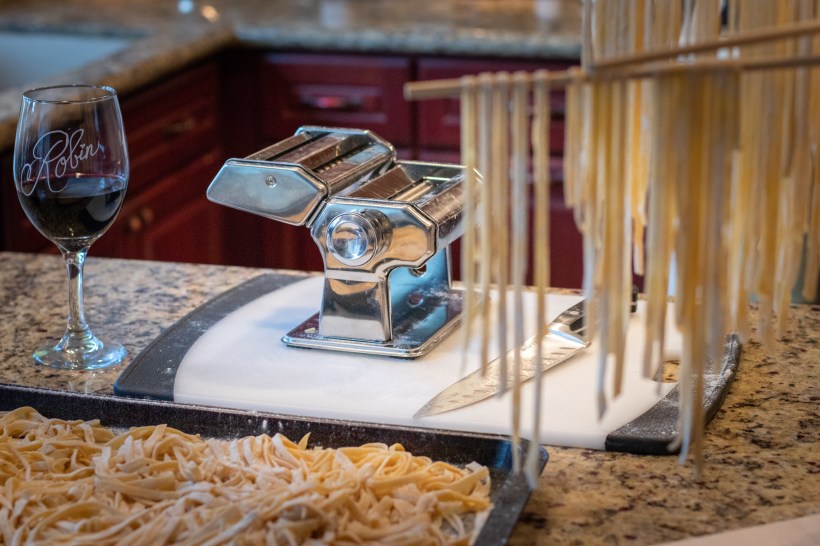
On a recent Sunday, I brought up my Robin’s Cooking Playlist on YouTube, poured a glass of wine, and then drizzled a little oil into my sauce pot. I added onions and garlic to saute, and pulled out the pasta maker. Shortly thereafter, a few of my children (now in their 20’s) came into the kitchen to see if they could help. With each of us, hands covered in flour, taking turns feeding the dough into the press while Dean Martin played in the background, I smiled and mused, “I hope my family-and others who have shared this experience in my kitchen-never forget they belong to something wonderful.”
 With Passion and Purpose