I walked down the center aisle and slipped into a pew near the front; its patina was dark and worn smooth with years of polishing. The old-world style chapel showcased an ornate altarpiece, and stained-glass windows lined the side corridors in lofty panels. I came here to escape and just be.
This particular evening a choral group was practicing (uncharacteristically) in the sanctuary, making it difficult to quiet my thoughts. On any other night the harmonic voices intertwined with the instrument’s tones and tempos would have been a lovely accompaniment to this beautiful space, but at that moment I only heard a cacophony of shrills.
Annoyed, I huffed trying to find something on which to focus my attention. The altar and ambo were adorned with lovely white orchids amidst a sea of greenery. Candles were lit and the smell of incense began to waft the heights, but my senses were unaffected.
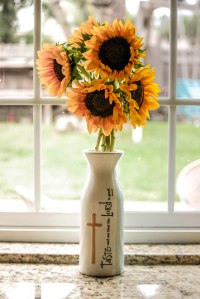 Peace and quiet. That’s all I wanted but it’s not what I was getting. Agitated and ready to depart, I took one more look around then saw it. A simple vase was placed under a small statue in the niche to my left. In it was a handful of bright yellow sunflowers. I closed my eyes and a little smile came over on my lips as an association came to mind.
In 2004, the private Catholic school, where our youngest daughter attends, purchased property to build their permanent campus. The first time I drove by to see it, I was caught off guard by the thousands of sunflowers carpeting the parcel. My first thought was, “How Providential that a garden of monstrances was planted on the land where our children would come to learn about Jesus and, hopefully, become like Him – little vessels radiating pure love into the world.”
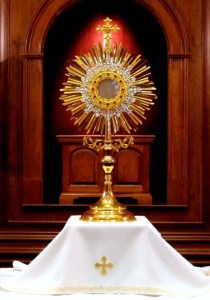 To those unfamiliar with the word, a monstrance reverently displays a consecrated Communion Host in a glass receptacle. It’s customarily surrounded by a starburst to replicate how Jesus, being the Light of the World, pours forth his light into our darkness. We use a monstrance in times of special prayer to honor and adore the true presence of Christ in the Eucharist. (For more on why we honor the Eucharist, see link below.)
The sunflowers in the niche ignited a cavalcade of thoughts. I was no longer distracted by the musicians, but moved to a place of observation and retrospect. The first thing I noticed was how those perky, bright yellow blooms stood out in such a formal chapel. The white orchids more suited the decor; elegantly poised with svelte stems, gracefully bending as if mingling aristocratically amongst one another.
“Those orchids…” I thought, “they are the ones in life who seem to have it all together: beautiful, refined, intelligent; sophisticates who know exactly what to say and when to say it. And refrain from speaking when they know that’s in order, too.”
I was still bemoaning an earlier event. While my heartfelt intent was to compliment someone, it was not received that way; instead, it upset them and was taken as an insult. I was beating myself up for opening my mouth in the first place. We’ve all been there, some of us more often than others. We speak before thinking and wham! We end up doing the opposite of what we set out to do. Our words are misconstrued and we feel like a complete idiot, wishing we could hail the TARDIS and go back in time.
A glance towards the orchids then back to the sunflowers. Cheerful, round faces attached to pudgy, thick stems stood crowded in the tiny vase. They didn’t seem to be too concerned about looking sleek or keeping their personal space. On the contrary, they appeared to be enjoying the closeness, gazing outward like a group of happy kindergartners huddled together shoulder to shoulder, smiling at everyone in the room.
Thoughts returned to the flower field and how it reminded me of the children who attended our school. “Innocent”, I mused. They were innocent of the world’s ideology, comfortable in their clumsy, immature bodies, and didn’t pretend to be something they weren’t. Putting on airs would never have crossed their minds. They spoke honestly and openly; having hearts wanting only to love.
Children don’t take what others say and try to read something into their words, suspiciously concocting scenarios in their heads, or overthinking things beyond their competency. When one gives a child a compliment, it’s received at face value, bight-eyed and most appreciatively.
These innocent souls are also quick to forgive when offended and just as quick to accept another’s mercy. How many times have we seen a child hurt by a playmate and, after an apology, the two quickly resume their play as if nothing happened? No brooding on the part of the afflicted, and no beating themselves up on the part of the afflictor; both understand having fun together is more important.
Matthew 18:3 came to mind, “Amen, I say to you, unless you turn and become like children, you will not enter the kingdom of heaven.” We think of heaven as a place of complete joy where one day we’ll eventually enter into its sanctuary of total bliss. But note how Jesus says we’re going to get there: We have to become like children. I doubt he means getting back into diapers. (Though, in most cases, that is what generally happens in our twilight years.) So what does becoming like children look like?
Think about the average toddler. They rely totally on their parents. If they’re hungry, they ask for food. If they’re in need of a hug, they crawl into their parent’s arms. Lonely, they clamor for attention. Scared, they run to daddy and mommy. They don’t worry about clothes, shoes, or material things. Theirs is the simplicity of humility; an innate understanding of their littleness and complete reliance on someone stronger, wiser and more capable of taking care of them.
Unless they’ve been taught to fear, most children at this age have a tremendous amount of trust in the world around them; they see only the best in people and desire to please. Slow to judge and quick to accept others (defects and all), they are anything but shy in showing affection. Their little hearts are bursting wide-open to share the joy bottled up inside.
I recall the cherub faces of my children at that age as they picked a droopy dandelion from the backyard and presented it to me with all the satisfaction of handing over three dozen roses; or their excitement in honoring me with a handmade card displaying a giant sun shooting multicolored beams out of its center where a rudimentary smiley face had been scrawled. As a parent, these small gestures of love were enough to melt my heart. It wasn’t the size of the gift, it was the love with which it was given.
All these attributes of a child manifest under one condition: having a trust and a security in one who loves them without limits. Before we were introduced to the cruelties of the world, we felt these conditions with our parents. We didn’t worry about materialistic things, have fear or anxiety, second-guess people, or need to guard ourselves. We assumed our parents would take care of our necessities. We approached life with boundless felicity, living in the moment, and absorbing all its goodness; usually with someone else. (Notice, too, how children don’t like being alone – they thrive when connecting with others because they perceive it’s an important element to being fully alive.)
Inevitably, because we are humans dealing with other humans, we get hurt. That’s a plain fact of life. If someone, or many people, let us down or breaks our trust over and again (or if we perceive God has let us down because he doesn’t deal with us in a way we think he should), we begin to develop an attitude of self-preservation. We take it upon ourselves to control our environments and extend it to the people in them. A hardened pride forms in thinking our way is best. With this also comes the great burden of the responsibility to make things perfect. When that fails (because we all know we can’t fix everything, all the time), fear and anxiety take over, followed by a lack of inner peace and joy.
This is what Jesus is talking about. He wants us to get rid of the pride of self-reliance, be secure in the knowledge that our Heavenly Father really does love us, will provide for us, has a wonderful plan for us, and wants us happy in this life, as well as in the next.
Pride is Satan’s best tool of combat because it masks things into being something good. I was told in my teen years, “have pride in your work”, “be proud of the family name”, and “show pride in how you dress, conduct yourself, etc.” These types of pride can be good – to a degree. If we do them because we want to honor our Heavenly Father they can be an example for helping others see His beauty.
However, if the root is to promote something good about one’s self, gained by our own accord to make us look impressive, it can turn into an inordinate self-esteem, inflated ego, or conceit, which becomes the onset of all of our sin. By the latter we make ourselves into a god, taking control into our own hands. While this might seem good, Satan smiles because he knows when we place our trust in ourselves, we eventually lose those elements of being a child of God, thus losing that inner joy of being childlike.
Once again staring at the orchids I thought, “While they may look lovely, they do not appear to be as happy as the sunflowers. They are elegant, yes, but they seem quite lonely.” I felt sad for them. Not for the flowers per se, but for the orchids in the world – those who miss out on joy because they’ve become preoccupied with presenting themselves under a particular guise; those who can’t seem to trust God, but choose to unnecessarily carry heavy burdens on their shoulders; those who go through life thinking they don’t need anyone because they’ve got it under control; those who live in fear and anxiety – always second-guessing their every move.
I came to the conclusion it was most fitting for those sunflowers to be there and to be placed under the statue of our Blessed Mother. I’m pretty sure little thought had been put into their placement in contrast with the orchids, but I saw it: Those under the watchful eye of Mary are joyful. I could almost hear her say as she did at the Wedding Feast at Cana, “Do whatever he tells you.” (John 2:5). As any good mother, she too, wants us happy. Her gentle nudging came as a reinforcement to my thoughts. Jesus wants us to trust that we have a good Father who can take care of us in order that we get accustomed to living in joy, now, here on earth, because there is no place in Heaven for human pride.
With my pride plucked, I shook my head. Yes, God does seem to give me what I need, when I need it instead of what I want sometimes. I may not have gotten the quiet like I wanted, but by providing an annoying group of singers to teach me a lesson, I did walk away with the peace. He knows I’m stubborn and just how drive home a point.
Being a sunflower didn’t look too bad- pudgy stalk, big round face and all. They may say things without tact, exhibit a clumsy awkwardness, and act stupid at times – even be disobedient here and there – but the bottom line is they are happy and full of life!
The following morning, I entered a store and was greeted by a display of sunflowers. I purchased a bunch and placed them in my kitchen (next to a statue of our Blessed Mother) as a reminder of my goal. We are all called to be vessels pouring forth His Light into the world by engaging in the childlike effervescence of loving, laughing, trusting and living!
Click here to learn more on how Catholics view The Eucharist.
 With Passion and Purpose